Telescope Gift Guide: The One Big Gift
The right telescope gift for a beginner is the Sky-Watcher Heritage 130P at around $305; for a serious visual observer with storage space it is the 8 inch Sky-Watcher Classic 200 at around $725; and for someone who wants photographs rather than eyepiece views it is the ZWO Seestar S30 Pro at around $699. Aperture, mount steadiness and the recipient's sky decide it, not magnification.
A telescope is the one gift in this hobby that decides everything after it, and it is also the gift most often chosen badly, because the box that says 500x on the side is the one that ends up in a cupboard. This guide matches seven telescopes to seven kinds of recipient: their experience, their sky, their storage space, and whether they want to look or to photograph. Each one is routed through the site's calculators so you can check the match against what they actually want to see. Every listing was verified in stock.
As an Amazon Associate we earn from qualifying purchases. How this site is funded.
How do you match a telescope to the person?
Four questions settle it. Have they used a telescope before? A first-timer needs a mount that does not shake more than they need aperture. What is their sky like? Under a bright suburban sky a beginner cannot see enough stars to star hop, so a telescope that finds things for them matters more. Where will it live? An 8 inch Dobsonian is 4 feet tall; a Schmidt-Cassegrain or a tabletop fits in a closet. Do they want to look, or to photograph? These are different hobbies that share a sky, and the wrong answer here is the most expensive mistake on this page.
Then there is the fact that sells or sinks every telescope gift: a telescope will not show the colours in a photograph. Night vision is nearly monochrome, so the Orion Nebula is grey-green mist and galaxies are faint smudges. What looks spectacular to the eye is the Moon, Saturn's rings, Jupiter's belts and moons, the Pleiades, double stars, and globular clusters in 8 inches or more. Say this out loud when you hand over the box. The what you can see by aperture chart is the honest version of the marketing photo.
Which telescope, for which recipient?
Aperture decides what a telescope can show, and the maths is simple: light grasp scales with the square of the aperture, so a 130 mm mirror gathers about 345 times the light of a dark-adapted eye and an 8 inch (203 mm) mirror about 841 times, which is 2.4 times more than the 130 mm. Maximum useful magnification is about 2x per millimetre, so 260x for the 130 mm and 406x for the 8 inch, though the atmosphere caps most nights at 200x to 250x regardless. Run the recipient's dream target through the telescope size calculator and it returns the minimum aperture; the table below does the rest.
| Recipient | Telescope | Aperture | Finds targets? | Storage |
|---|---|---|---|---|
| First telescope, any adult or teen | Sky-Watcher Heritage 130mm Tabletop Dobsonian | 130 mm | No | Closet shelf |
| Beginner, bright suburban sky | Celestron StarSense Explorer DX 130AZ | 130 mm | Phone guided | Closet, tripod folded |
| Beginner who wants tracking | Sky-Watcher Virtuoso GTi 150P Tabletop GoTo Dobsonian | 150 mm | Yes, GoTo | Closet shelf |
| Serious visual observer | Sky-Watcher Classic 200 Dobsonian 8 inch | 203 mm | No | Garage corner, 4 ft tall |
| Serious observer, wants help finding | Celestron StarSense Explorer 8 inch Dobsonian | 203 mm | Phone guided | Garage corner, 4 ft tall |
| Planets, tracking, small space | Celestron NexStar 8SE | 203 mm | Yes, GoTo | Closet, assembled |
| Wants photographs, not views | ZWO Seestar S30 Pro Smart Telescope | 30 mm | Yes, automatic | A shoebox |
The first telescope: Heritage 130P
The Sky-Watcher Heritage 130mm Tabletop Dobsonian is what this site recommends to every beginner, and best telescope for beginners lays out why in full. The short version: the mount matters more than the telescope, a tabletop Dobsonian base is the only mount under $350 that does not shake, and 130 mm is the smallest aperture that shows the Cassini division and real structure in the Orion Nebula. It needs a garden table or a car boot to sit on, and it needs collimating occasionally, which a Cheshire eyepiece from the under-$50 guide handles. The beginner telescope setup shows it as the centre of a complete first kit with a running total.
The suburban beginner: StarSense Explorer DX 130AZ
Under a bright sky, a beginner with a manual telescope sees a dozen stars and cannot find anything. The Celestron StarSense Explorer DX 130AZ fixes exactly that: a phone in the dock photographs the star field, plate-solves it, and on-screen arrows walk the user onto the target. Nothing is motorised, so there are no batteries in the telescope and no alignment routine. The tripod is lighter than a tabletop base and benefits from vibration pads. Read the DX 130AZ review and the Bortle scale chart to judge how bright the recipient's sky really is; from Bortle 6 and up this is the better first telescope.
The beginner who wants tracking: Virtuoso GTi 150P
The Sky-Watcher Virtuoso GTi 150P Tabletop GoTo Dobsonian is the answer to "I want it to find things and follow them" at a price where most GoTo telescopes put a tiny tube on a shaky tripod. It puts a 150 mm mirror on a motorised tabletop base driven from a phone app, so the money went into the glass and the tracking is a bonus. It needs a table and a USB power bank, and it is the telescope for the beginner who is honest that they will not learn the sky.
The serious visual observer: Classic 200 Dobsonian
Ask any group of experienced observers what to buy and the 8 inch Dobsonian is the answer. The Sky-Watcher Classic 200 Dobsonian 8 inch gathers 2.4 times the light of a 130 mm, resolves globular clusters into individual stars, and shows the Cassini division on a mediocre night. It is manual, so the recipient learns the sky, which is a feature to the right person and a barrier to the wrong one. It is also 4 feet tall and about 40 lb. Our Dobsonian roundup and the Classic 200 review cover the detail; the spec page has every computed figure.
The serious observer who wants help: StarSense Explorer 8 Dobsonian
The Celestron StarSense Explorer 8 inch Dobsonian is the Classic 200's optics with the phone plate-solving dock bolted on, for about $150 more. For someone who did not grow up star hopping, that is the difference between seeing a galaxy on the first night and giving up on the third. It is the 8 inch this site recommends to most first-time 8 inch buyers, and the full review explains the one caveat, which is that the phone does the finding and the owner still does the nudging.
Planets and small storage: NexStar 8SE
The Celestron NexStar 8SE is the gift for the person who wants Jupiter and Saturn at 200x, held steady in the eyepiece by a tracking mount, from a telescope that fits in a closet assembled. A Schmidt-Cassegrain folds a 2,032 mm focal length into a 17 inch tube, and the GoTo fork finds 40,000 objects. It needs a power tank or batteries, it needs 30 to 45 minutes of cool-down, and under a dark sky an 8 inch Dobsonian at half the price shows deep sky objects at least as well. The 8SE review and the planet viewing by aperture chart show what it does best.
Photographs, not views: Seestar S30 Pro
The ZWO Seestar S30 Pro Smart Telescope has no eyepiece and no learning curve. It sits on a small tripod, aligns itself, and stacks exposures into a colour image of the Orion Nebula on a phone in ten minutes, from a city garden. Its aperture is 30 mm, which is why it does nothing useful on planets, and why it is the wrong gift for someone who wants to look through a telescope. For someone who has always wanted the photograph, it is the best value on this page. The Seestar S30 Pro review and the Seestar S30 Pro spec page settle which experience the recipient is after.
The one big gift, by recipient

Sky-Watcher Heritage 130mm Tabletop Dobsonian
The default first telescope. Steady tabletop base, collapsible tube, real aperture. Give it with a wide eyepiece and a red headlamp and the recipient has everything they need for a year.
Best for: A beginner with a garden table or a car boot
Check price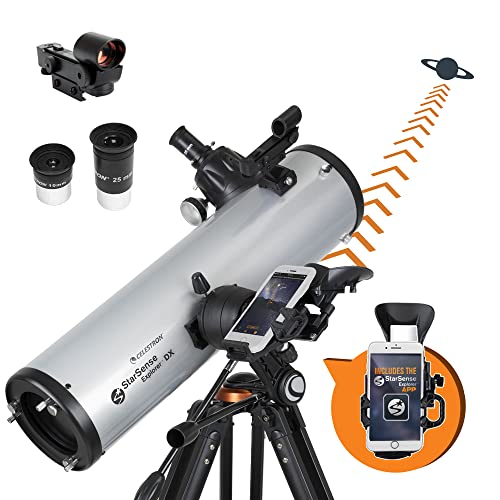
Celestron StarSense Explorer DX 130AZ
The same 130 mm f/5 optics on a full tripod, with a phone dock that plate-solves the sky and walks the user to targets with arrows. Nothing motorised, so no batteries, no alignment. It removes the one thing that makes suburban beginners quit: not being able to find anything.
Best for: A beginner in a light-polluted suburb who cannot star hop yet
Check price
Sky-Watcher Virtuoso GTi 150P Tabletop GoTo Dobsonian
A 150 mm tabletop Dobsonian with a motorised base driven from a phone app, so it finds and tracks targets. The only GoTo under $500 that puts the money into a 6 inch mirror instead of a tripod. Needs a table and a power bank.
Best for: A beginner who wants tracking without paying for a mount
Check price
Sky-Watcher Classic 200 Dobsonian 8 inch
The 8 inch Dobsonian is the telescope experienced observers own and recommend. Most aperture per dollar of anything on the page, no batteries, nothing to fail. It is 4 feet tall and 40 lb, so check for storage before giving it.
Best for: Someone who will learn the sky and has room to store it
Check price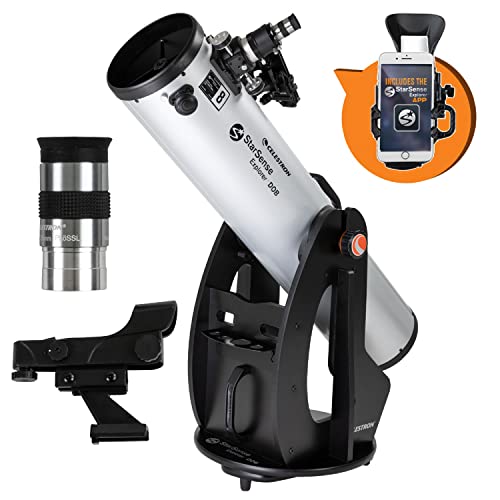
Celestron StarSense Explorer 8 inch Dobsonian
The 8 inch Dobsonian with the phone plate-solving dock bolted on. About $150 over the Classic 200 buys first-night success on galaxies the recipient has never seen. The right 8 inch for most people who did not grow up star hopping.
Best for: An 8 inch buyer who does not want to learn the sky first
Check price
Celestron NexStar 8SE
An 8 inch Schmidt-Cassegrain on a GoTo fork: it finds 40,000 objects and tracks them so Jupiter stays centred at 200x. The tube is 17 inches long and fits in a closet assembled. Needs power and 30 to 45 minutes of cool-down before it performs.
Best for: The person who wants planets and has nowhere to store a Dobsonian
Check price
ZWO Seestar S30 Pro Smart Telescope
No eyepiece. It aligns itself, stacks exposures and shows a colour image of a nebula on a phone in ten minutes, from a suburban garden. It is the gift for someone who has always wanted the picture, and the wrong gift for someone who wants to look through a telescope.
Best for: A phone-first recipient in a bright city
Check pricePrices change often, confirm on Amazon. As an Amazon Associate we earn from qualifying purchases.
The imaging gift: when they already own a camera
If the recipient has a DSLR or mirrorless camera and keeps photographing the Milky Way from a tripod, the big gift is not a telescope at all. It is a tracking mount. Long exposures need the camera to follow the sky, and the Sky-Watcher Star Adventurer GTi Mount Head Kit is a genuine GoTo equatorial head rated for 11 lb of imaging payload, which is enough for a camera and a lens now and an 80 mm refractor later. That refractor is the Sky-Watcher Evostar 80EDX APO Doublet Refractor : short, light, free of collimation and of the diffraction spikes a reflector adds. Together they are the beginner astrophotography setup this site prices out in full. Check the payload maths in the mount payload calculator; for imaging, a mount loaded past about two thirds of its rating loses stars to vibration. The star tracker roundup covers the lighter options for a camera and lens alone.
The imaging pair

Sky-Watcher Star Adventurer GTi Mount Head Kit
A GoTo equatorial mount head rated for 11 lb of imaging payload. This, not a telescope, is the purchase that turns a DSLR owner into an astrophotographer, because tracking is what long exposures need.
Best for: The person who already owns a camera and a wide lens
Check price
Sky-Watcher Evostar 80EDX APO Doublet Refractor
An 80 mm ED doublet is the standard first serious imaging telescope: short, light, forgiving of mount error, and free of collimation. On the Star Adventurer GTi it is a complete deep sky imaging rig.
Best for: Someone who already has the mount above
Check pricePrices change often, confirm on Amazon. As an Amazon Associate we earn from qualifying purchases.
What to check before you buy
- Mount first. Dobsonian base, GoTo fork, or a real mount head on a real tripod. If the listing photo shows a spindly aluminium tripod under a long tube, walk away.
- Aperture in millimetres. Never magnification. Maximum useful power is about 2x per millimetre and the atmosphere rarely allows more than 250x anyway; the magnification calculator shows the ceiling for any telescope.
- Where it lives. Measure the closet. An 8 inch Dobsonian is 4 feet tall; a tabletop Dobsonian is 2 feet; an 8SE is 17 inches of tube on a fork.
- Power. GoTo and smart telescopes need it. Dobsonians do not.
- What comes in the box. Almost always a 25 mm and a 10 mm eyepiece and a poor finder. Add a wide eyepiece, a red headlamp and Turn Left at Orion from the under $50 guide.
For the whole decision in one page, how to choose a telescope is the site's long-form answer, and gifts for astronomy lovers covers everything around the telescope, from mounts and chairs down to stocking stuffers.
Frequently asked questions
Which telescope is the best gift for a beginner?
The Sky-Watcher Heritage 130P tabletop Dobsonian at around $305. It is the only mount type under $350 that does not shake, it needs no batteries or alignment, and 130 mm of aperture shows Saturn's rings, Jupiter's belts and moons, lunar craters and the brighter deep sky objects. If the recipient lives under bright suburban skies, the Celestron StarSense Explorer DX 130AZ adds phone-guided pointing for about $110 more.
Is an 8 inch Dobsonian too much telescope for a gift?
Not optically, and it is what most experienced observers recommend. The practical questions are storage and weight: a Sky-Watcher Classic 200 is about 4 feet tall and 40 lb, and it lives in a garage corner or a closet. If the recipient has that space and will learn the sky, it is the gift they keep for decades. If they will not learn the sky, the StarSense Explorer 8 inch adds phone-guided finding for about $150 more.
Should I give a GoTo telescope?
Only if the recipient wants planets and tracking, or has nowhere to store a Dobsonian. A GoTo telescope like the Celestron NexStar 8SE finds and tracks objects, which is a real advantage at high magnification, but it costs more than twice what an 8 inch Dobsonian does for the same aperture, needs power, and needs a 30 to 45 minute cool-down. For deep sky viewing under a dark sky, the Dobsonian shows more for less.
Is a smart telescope a good gift?
For someone who wants photographs of nebulae and galaxies, yes: the ZWO Seestar S30 Pro produces colour images from a suburban garden in minutes with no skill required. For someone who wants to look through an eyepiece, no, because it has none. Ask which experience the recipient is after before choosing. The two are different hobbies that share a sky.
How do I match a telescope to what they want to see?
Aperture decides it. The Moon and the planets look good in anything from 80 mm up; the Cassini division and the Great Red Spot want 130 mm and steady air; globular clusters resolve into stars at about 200 mm; galaxies beyond the brightest few need 200 mm and a dark sky. The telescope size calculator on this site takes a target and returns the aperture it needs.
What should come with the telescope?
A red headlamp, a low-power wide-field eyepiece if the box only has a 25 mm and a 10 mm, and a copy of Turn Left at Orion. For a reflector, a Cheshire collimation eyepiece. For a GoTo or smart telescope, a power bank. These are all under $50 and covered in the companion guide, and they are the difference between a telescope that gets used and one that lives in a cupboard.
How we choose: we compare published manufacturer specifications, optical figures we can verify, and reviews from owners who have used the equipment under real skies. We do not test gear in person. Never point any telescope, finder or binocular at the Sun without a certified full-aperture solar filter fitted over the front of the instrument.
Recording your own eyepieces, exit pupils and sessions? The Observing & Astrophotography Planner is the paid version of these pages: 8 printable worksheets you fill in with your own numbers, plus the full PDF, $29.