Astronomy Gifts Under $50
The best astronomy gift under $50 is a Celestron Omni 32 mm Plossl eyepiece, because bundled telescopes come with a 25 mm and a 10 mm and nothing wider, and a 32 mm fits almost every telescope sold. A variable Moon filter and a red headlamp are the next two most-used accessories at any price.
The best astronomy gifts under $50 are the accessories a telescope owner uses every single session and rarely buys for themselves: a wide eyepiece, a Moon filter, a red headlamp, a collimation tool, a book that shows what the eyepiece really reveals. These 20 picks are grouped by what they do, each one says what it replaces and what to check before buying, and every listing was verified in stock. Nothing here is a novelty. All of it fits the 1.25 inch standard that nearly every beginner and intermediate telescope uses.
As an Amazon Associate we earn from qualifying purchases. How this site is funded.
How to pick a telescope accessory as a gift
Three questions sort almost every accessory. What size is the focuser? Nearly every telescope under $1,000 takes 1.25 inch eyepieces and filters, and everything optical on this page is 1.25 inch. Is it a reflector? Newtonians and Dobsonians need collimating; refractors, Maksutovs and Schmidt-Cassegrains effectively do not, so collimation tools are only a gift for reflector owners. What did the box include? Most bundled telescopes ship with a 25 mm and a 10 mm eyepiece, a poor finder, and no filters, so a wide eyepiece, a Barlow and a Moon filter are almost never duplicates.
If you know the recipient's telescope, the eyepiece calculator shows which focal lengths fill the gaps in their set, and the magnification calculator shows what a Barlow would do with what they already own. If you do not know it, the picks in the learning section fit every telescope ever made.
Eyepieces and Barlows under $50
Eyepiece advice is usually given in focal length, which does not transfer between telescopes; the number that does is exit pupil, and the eyepiece roundup explains how to plan a set around it. For a gift the practical rule is simpler: give the widest eyepiece the telescope can use, because that is the one the box never includes. The Celestron Omni 32mm Plossl Eyepiece is that eyepiece for any telescope at f/5 or slower. For a fast f/4 tube it produces an exit pupil wider than the eye can use, in which case the SVBONY SV135 7mm to 21mm Zoom Eyepiece is the safer choice.
| Gift | What it does | Check first | Tier |
|---|---|---|---|
| Celestron Omni 32mm Plossl Eyepiece | Widest low-power view | Focal ratio f/5 or slower | Around $50 |
| SVBONY SV135 7mm to 21mm Zoom Eyepiece | 21 mm to 7 mm in one barrel | 1.25 inch focuser | Around $50 |
| Celestron Omni 1.25 inch 2x Barlow Lens | Doubles every eyepiece | Recipient has no Barlow | Around $35 |
| SVBONY 2x Barlow Lens, 1.25 inch | Budget 2x Barlow | Same | Around $18 |
A Barlow is the better gift than a fourth eyepiece for most owners: the Celestron Omni 1.25 inch 2x Barlow Lens turns a 25 mm and a 10 mm into four magnifications, and paired with the 32 mm it makes a complete low, medium and high power set from three pieces of glass. Skip 3x and 5x Barlows for beginner telescopes; they produce magnifications the atmosphere will not support on most nights.
Eyepieces and Barlows

Celestron Omni 32mm Plossl Eyepiece
The widest, lowest-power view most telescopes can reach. In an f/5 reflector it gives a 6.4 mm exit pupil, right at the edge of what a dark-adapted eye can use, so check the focal ratio first.
Best for: Any telescope with only the bundled eyepieces
Check price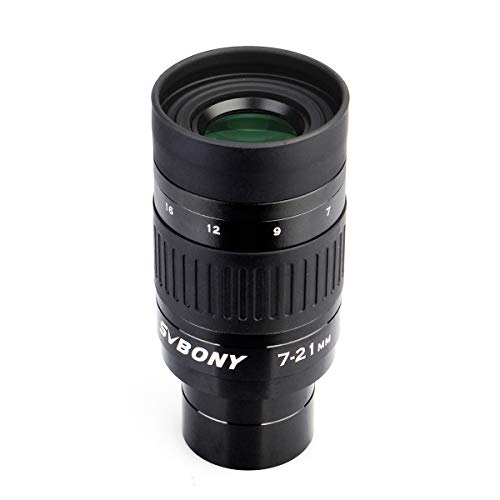
SVBONY SV135 7mm to 21mm Zoom Eyepiece
One eyepiece covering 21 mm to 7 mm. A beginner turns the barrel instead of swapping eyepieces in the dark. Fixed eyepieces are sharper at any single setting; nothing is this convenient at this price.
Best for: A beginner who finds swapping eyepieces fiddly
Check price
Celestron Omni 1.25 inch 2x Barlow Lens
A 2x Barlow doubles the magnification of every eyepiece the recipient owns, so three eyepieces become six magnifications. It is usually a better purchase than a fourth eyepiece.
Best for: Someone with two or three eyepieces and no Barlow
Check price
SVBONY 2x Barlow Lens, 1.25 inch
A metal-bodied 2x Barlow at a stocking-stuffer price. Slightly less refined than the Celestron Omni, and a fine first Barlow for a tabletop reflector.
Best for: A first Barlow on a tight budget
Check pricePrices change often, confirm on Amazon. As an Amazon Associate we earn from qualifying purchases.
Filters that actually change the view
Two filters earn their place on almost any telescope and the rest are optional. The Celestron Variable Moon Filter matters because the Moon is what beginners look at most and it is painfully bright at low power in anything over 100 mm; a variable polariser lets the owner dial the glare down until crater shadows return. The SVBONY 1.25 inch UHC Filter is the one for a suburban observer who likes nebulae. It passes the emission lines nebulae glow in and blocks most of the sky glow, which the light pollution guide and the filter roundup both cover in detail. Tell the recipient it does nothing for galaxies or star clusters, so the gift lands with the right expectations.
| Gift | Helps with | Does nothing for | Tier |
|---|---|---|---|
| Celestron Variable Moon Filter | Moon glare, variable | Anything faint | Around $43 |
| SVBONY 1.25 inch UHC Filter | Emission nebulae in suburbs | Galaxies, clusters | Around $28 |
| Celestron EclipSmart Universal Full-Aperture Solar Filter | Sunspots, safely | Anything at night | Around $22 |
| Celestron 1.25 inch Moon Filter | Moon glare, fixed | Anything faint | Around $11 |
The Celestron EclipSmart Universal Full-Aperture Solar Filter is a different kind of gift. Fitted over the front of a small telescope, it makes sunspots safe to observe in daylight, which doubles the hours a telescope gets used. It must go on the front of the instrument, never at the eyepiece end. Read how to observe the Sun safely and pass it on with the gift; the solar filter roundup covers sizes for larger telescopes.
Filters

Celestron Variable Moon Filter
Two polarising elements that dim the Moon from painful to comfortable as you rotate them, so crater shadows stop washing out. The Moon is the target beginners look at most, and this is the accessory that makes it comfortable.
Best for: Anyone whose telescope mostly points at the Moon
Check price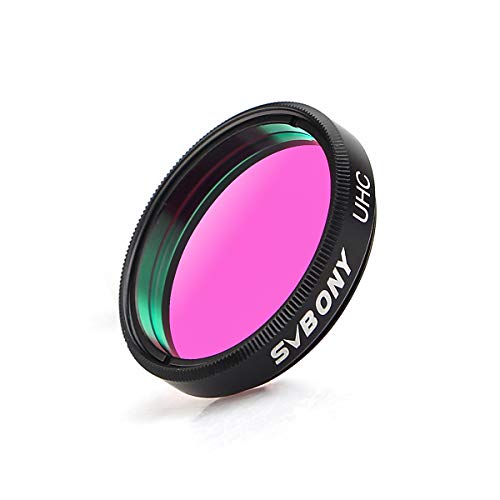
SVBONY 1.25 inch UHC Filter
An ultra-high-contrast filter passes the wavelengths emission nebulae glow in and blocks most of a suburban sky. The Orion Nebula and the Lagoon gain visible contrast; galaxies and star clusters do not, and the recipient should know that.
Best for: A suburban observer who likes nebulae
Check price
Celestron 1.25 inch Moon Filter
A fixed neutral-density Moon filter at the lowest price on this page. It threads into any 1.25 inch eyepiece and cuts glare enough for a comfortable lunar session.
Best for: A stocking stuffer for a new telescope owner
Check price
Celestron EclipSmart Universal Full-Aperture Solar Filter
A certified full-aperture solar filter that fits over the front of a small telescope and makes sunspots safe to observe. It is the only safe way to point a telescope at the Sun, and the site guide on solar observing explains how to fit it.
Best for: Turning a night hobby into a daytime one, safely
Check pricePrices change often, confirm on Amazon. As an Amazon Associate we earn from qualifying purchases.
Books, charts and the red headlamp
Nothing on this page improves a first year with a telescope as much as Turn Left At Orion . Its drawings are made from the eyepiece rather than from photographs, so a new owner learns that the Ring Nebula is a tiny grey smoke ring and the Andromeda Galaxy a soft oval, and stops feeling they are doing something wrong. NightWatch: A Practical Guide to Viewing the Universe is the companion for someone who wants to understand what they are looking at rather than tour it. Both fit every telescope and every sky, which makes them the safe pick when you do not know what the recipient owns.
The Celestron Night Vision Red LED Headlamp is the most-used accessory at any observing session, for a reason the site explains in using a telescope for the first time: dark adaptation takes 20 to 30 minutes and a white phone screen resets it instantly. A red headlamp keeps both hands free for eyepieces and charts. The The Night Sky Planisphere, 30 to 40 Degrees North is the low-tech chart that shows which constellations are up right now, and it never needs charging.
Learning and finding

Turn Left At Orion
Drawn from the eyepiece rather than photographed, so it shows what a small telescope actually reveals and how to find it. The single best book for a first-year telescope owner.
Best for: Every new telescope owner
Check price
NightWatch: A Practical Guide to Viewing the Universe
Season-by-season charts, honest telescope advice and a clear explanation of what the eye actually sees. Experienced observers name it as the book that taught them.
Best for: Someone who wants to understand the sky, not just tour it
Check price
The Night Sky Planisphere, 30 to 40 Degrees North
A rotating star wheel that shows which constellations are up on any date and hour, for the 30 to 40 degree north latitudes that cover most of the United States. No battery, no screen glare.
Best for: Learning the sky without a phone
Check price
Celestron Night Vision Red LED Headlamp
Red light preserves the 20 to 30 minutes of dark adaptation a phone screen ruins instantly, and a headlamp keeps both hands free for eyepieces and charts.
Best for: Anyone who observes, full stop
Check pricePrices change often, confirm on Amazon. As an Amazon Associate we earn from qualifying purchases.
Collimation and care
Every Newtonian reflector and Dobsonian needs collimating, and most beginners never do it because nobody gave them the tool. A SVBONY SV197 Cheshire Collimating Eyepiece is the reliable choice: it cannot go out of alignment itself, and the collimation guide walks through it in ten minutes. The SVBONY Laser Collimator for Newtonian Telescopes is quicker in the dark and the tool most owners reach for once they know the routine, with the caveat that a cheap laser should itself be checked in a V-block. Refractor, Maksutov and Schmidt-Cassegrain owners do not need either, so ask what they own.
| Gift | For | Tier |
|---|---|---|
| SVBONY SV197 Cheshire Collimating Eyepiece | Reflectors only | Around $30 |
| SVBONY Laser Collimator for Newtonian Telescopes | Reflectors only | Around $25 |
| Celestron Lens Cleaning Kit | Any telescope | Around $20 |
| Celestron LensPen Optics Cleaning Tool | Eyepieces and finders | Around $12 |
| Astromania Telescope Eyepiece and Accessory Case | Three or more eyepieces | Around $50 |
Cleaning gear is the other half. Optics need cleaning far less often than beginners think, and the damage almost always comes from a shirt sleeve on a dusty lens. The Celestron Lens Cleaning Kit and the Celestron LensPen Optics Cleaning Tool cover eyepieces and objectives properly, and the maintenance guide explains when not to clean at all.
Collimation and care

SVBONY SV197 Cheshire Collimating Eyepiece
A Cheshire eyepiece is the reliable way to collimate a Newtonian reflector, and every reflector on this site needs collimating. It cannot go out of alignment itself, which is the advantage over a laser.
Best for: Any Dobsonian or Newtonian owner
Check price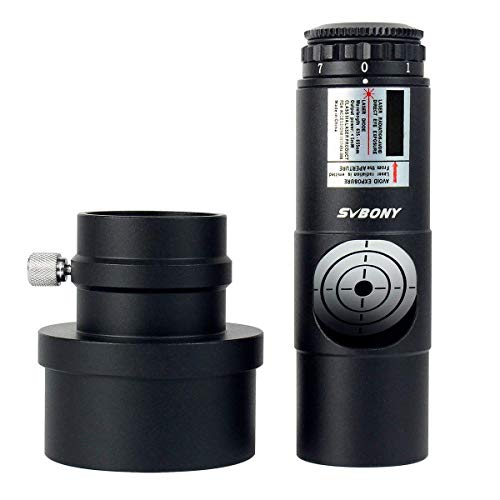
SVBONY Laser Collimator for Newtonian Telescopes
Faster than a Cheshire in the dark, and satisfying to use. Owners should check the laser itself is collimated in a V-block before trusting it; the site collimation guide explains how.
Best for: A reflector owner who collimates often
Check price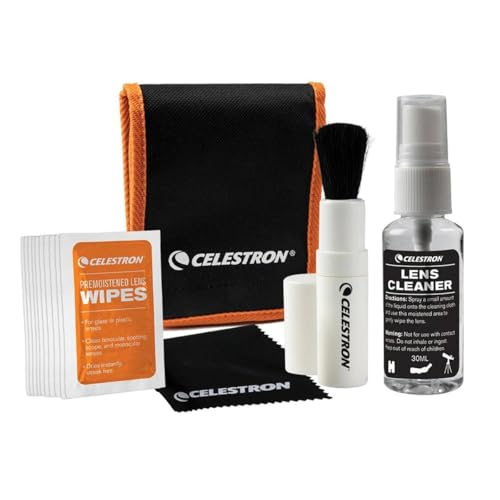
Celestron Lens Cleaning Kit
Brush, blower, fluid and lint-free tissue. Optics need cleaning far less often than beginners think, so a kit lasts years and stops the sleeve-wipe that scratches coatings.
Best for: A stocking stuffer that saves a lens
Check price
Celestron LensPen Optics Cleaning Tool
A retractable brush and a carbon cleaning tip sized for eyepieces and finder lenses. It lives in the eyepiece case and gets used every session.
Best for: The eyepiece case
Check price
Astromania Telescope Eyepiece and Accessory Case
A foam-lined aluminium case that stops eyepieces rolling around a bag. Owners who get one stop losing dust caps and start bringing all their eyepieces outside.
Best for: Someone with three or more eyepieces and no case
Check pricePrices change often, confirm on Amazon. As an Amazon Associate we earn from qualifying purchases.
Comfort, power and the odd useful adapter
The Astromania Anti-Vibration Pads for Telescope Tripods are the fix for the single most common telescope complaint: the image shaking at high power on a lightweight tripod. Three pads under the tripod feet damp the vibration in a second or two instead of five, which is the difference between usable and not at 150x. The Celestron PowerTank Glow 5000mAh Power Bank runs a phone star chart or a small dew heater all night and has a red flashlight built in. The Astromania T2 T-Ring and T-Adapter for Canon EOS is the one specialist item here: it connects a Canon EF camera to a telescope focuser for prime-focus Moon photos, and it is only a gift for someone who owns that camera, as our Moon photography guide explains.
Comfort and power

Celestron PowerTank Glow 5000mAh Power Bank
A 5,000 mAh USB power bank with a built-in red flashlight, sized for a phone running a star chart app or a small dew heater. The red light alone justifies it.
Best for: A phone-app observer
Check price
Astromania Anti-Vibration Pads for Telescope Tripods
Three pads that sit under tripod feet and damp the shake that ruins high-power views on lightweight mounts. The cheapest fix for the most common telescope complaint.
Best for: Any telescope on a tripod that shakes at high power
Check price
Astromania T2 T-Ring and T-Adapter for Canon EOS
A T-ring and adapter connects a Canon DSLR to a telescope focuser for prime-focus Moon photos. Check the camera brand: this one is for Canon EF mount bodies.
Best for: A Canon owner who wants to shoot the Moon through the telescope
Check pricePrices change often, confirm on Amazon. As an Amazon Associate we earn from qualifying purchases.
Want to spend more?
Above $50 the gifts change character: an observing chair, a proper finder, 15x70 binoculars, and then the telescopes themselves. Our gifts for astronomy lovers guide covers all of it in price tiers, and the telescope gift guide matches the one big gift to the person. The beginner telescope setup shows how these small pieces add up to a complete first kit.
Frequently asked questions
What is the best astronomy gift under $50?
A Celestron Omni 32 mm Plossl eyepiece at around $50. Bundled telescopes ship with a 25 mm and a 10 mm and nothing wider, so a 32 mm gives the recipient a wide, low-power view they do not have, and it fits almost every 1.25 inch focuser sold. If they already own a wide eyepiece, a variable Moon filter or a red headlamp are the next most-used accessories.
Will these accessories fit any telescope?
Nearly all of them. Everything optical on this page uses the 1.25 inch standard, which covers almost every beginner and intermediate telescope. The exceptions are collimation tools, which are only for reflectors, and the T-ring, which is specific to Canon EF cameras. If the recipient has a 2 inch focuser they will usually also have a 1.25 inch adapter.
Is a zoom eyepiece a good gift?
For a beginner, yes. A 7 mm to 21 mm zoom replaces three eyepiece swaps in the dark with a turn of the barrel, and that convenience keeps new owners observing longer. Fixed eyepieces are sharper at any one focal length and have wider fields, so it is a starting point rather than an end point, and the honest trade-off is a narrower view at the long end.
Are telescope filters worth it as gifts?
A Moon filter is, for anyone who observes the Moon, because it makes the brightest object in the sky comfortable and reveals crater detail that glare hides. A UHC filter helps emission nebulae from a suburban sky and does nothing for galaxies or clusters, which the recipient should be told. Colour planetary filters are the ones to skip; owner consensus is that they rarely earn their place.
What should I not buy a telescope owner?
Anything sold on magnification, any eyepiece under about 4 mm, an eyepiece-end solar filter (dangerous, and every serious source says to throw them away), and a cheap lightweight tripod. A 3x Barlow on a beginner telescope produces magnifications the atmosphere will not support. When in doubt, a book or a red headlamp is never wrong.
How we choose: we compare published manufacturer specifications, optical figures we can verify, and reviews from owners who have used the equipment under real skies. We do not test gear in person. Never point any telescope, finder or binocular at the Sun without a certified full-aperture solar filter fitted over the front of the instrument.
Recording your own eyepieces, exit pupils and sessions? The Observing & Astrophotography Planner is the paid version of these pages: 8 printable worksheets you fill in with your own numbers, plus the full PDF, $29.