Best Solar Filter for a Telescope
The only safe solar filter is a certified full-aperture filter fitted over the FRONT of the telescope, such as the Celestron EclipSmart Universal Solar Filter at about $22 or a Thousand Oaks solar film sheet at about $20. Filters that thread onto an eyepiece sit at the focus, can crack from concentrated heat while you are looking through them, and cause instant permanent blindness.
There is exactly one safe arrangement, and everything else on the market that claims otherwise is dangerous. A certified full-aperture solar filter fits over the FRONT of the telescope and rejects roughly 99.999 percent of the sunlight before it enters the tube. The correct first purchase is the Celestron EclipSmart universal filter at about $22, which clamps over the objective end of almost any telescope up to eight inches.
Why does the filter have to go at the front?
Because a telescope is a machine for concentrating light, and the whole point of the filter is to stop that concentration from happening.
An 8 inch telescope has an aperture area roughly 850 times that of a dark adapted 7 mm pupil, and it focuses all of that energy into a spot a few millimetres across at the eyepiece. A filter placed in front of the objective removes the energy before any of it is collected: the glass behind it stays cool, nothing is under thermal stress, and the failure mode of the filter is that it falls off, which you notice instantly because the view goes white.
A filter placed at the eyepiece sits inside the concentrated beam. The entire collected output of the Sun is landing on a piece of glass the diameter of a pencil. It gets extremely hot, thermal stress builds, and it can crack in seconds with no warning. The failure mode there is that the full beam reaches your retina while your eye is pressed to the eyepiece, and the retina contains no pain receptors, so there is no reflex to pull away. The damage is done before you know anything has happened, and it is permanent.
This is not a theoretical risk written up by a cautious lawyer. Eyepiece sun filters were standard in cheap department store telescope bundles for decades and they injured people regularly enough that essentially every reputable manufacturer stopped supplying them. Some still ship with the very cheapest telescopes, and secondhand telescopes come with them in the accessory box constantly.
What should you buy?
Two categories cover almost everyone, and the difference between them is whether you want a finished product or a sheet of material to build with.
Certified full-aperture solar filters

Celestron EclipSmart Universal Full-Aperture Solar Filter
A certified full-aperture filter in a universal frame that clamps over the front of the tube, with adjustable tabs to fit a range of diameters. It is the cheapest correct answer, and correct is the only category that matters here.
Best for: Any telescope up to about 8 inches, and the filter to buy first
Check price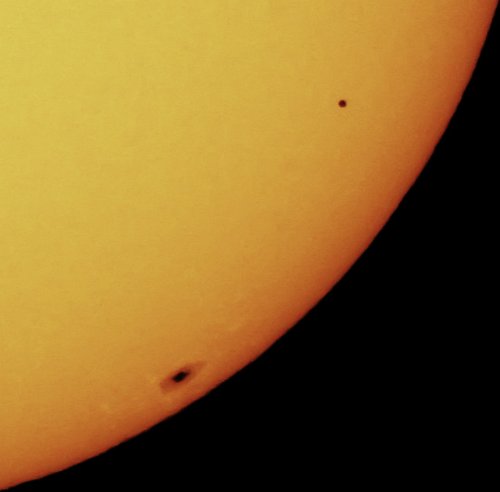
Thousand Oaks 8x8 inch Solar Filter Sheet
Certified solar film in an 8 by 8 inch sheet, intended to be built into a cell that fits the front of your own tube. It gives a neutral to slightly warm image and lets you filter a telescope, a finder and a camera lens from one sheet.
Best for: Anyone comfortable making a rigid, secure cell that cannot fall off
Check pricePrices change often, confirm on Amazon. As an Amazon Associate we earn from qualifying purchases.
The EclipSmart universal filter is a finished frame with adjustable tabs that grip the outside of the tube. Check the fit before the first use in daylight with the telescope pointed at the ground, and specifically check that it cannot be knocked off by a sleeve or a breeze. Some people add a strip of tape as a belt and braces measure, which is sensible rather than paranoid.
Thousand Oaks solar film is the same certified material sold as a sheet, intended to be built into a cell of your own. Per square inch it is much cheaper, and one 8 by 8 inch sheet will filter a small telescope, a finder and a camera lens. Build the cell out of something rigid, make it a firm friction fit rather than a loose slip fit, and inspect the film against a bright indoor light every single time before use. Pinholes and scratches are the failure mode, and they are visible if you look.
What must you never use?
Every item on this list has injured somebody. None of them is a shortcut, a budget option, or something that works if you are careful.
| Item | Why people try it | Why it is dangerous |
|---|---|---|
| Eyepiece-end sun filter | It came with the telescope and says sun on it | Sits at the focus of the concentrated beam. Cracks from thermal stress with no warning |
| Eclipse glasses held behind an eyepiece | They are certified for the Sun | Certified for the naked eye only. The concentrated beam burns straight through the film |
| Exposed photographic film | Old books recommended it | Blocks visible light and passes infrared, so it feels comfortable while cooking the retina |
| Smoked glass | It looks dark enough | Uneven density, unknown infrared transmission, and it can shatter from heat |
| Stacked sunglasses or polarising filters | They look very dark stacked | Reduce visible brightness only. Neither blocks infrared, and both fail at the focus |
| CDs, mylar food packaging, floppy disk media | They look like solar film | Not optically flat, not certified, unknown transmission, and full of pinholes |
| Welding glass below shade 14 | Shade 14 is sometimes said to be acceptable | Only shade 14 or darker, and only for brief naked eye use, never behind an optic |
| Projection onto card with a Cassegrain or Maksutov | Projection is safe with a small refractor | Closed tube designs trap heat and can crack the corrector or damage internal baffling |
Two things on that table need saying again because they are the ones people argue about. Eclipse glasses are for your eyes and nothing else. The certification is for unconcentrated light. And solar projection is only safe with a small unobstructed refractor, where you point the telescope at the Sun without looking through it and catch the projected image on white card held behind the eyepiece. Never do it with a Schmidt-Cassegrain or a Maksutov, and never leave any telescope pointed at the Sun unattended for even a moment with children nearby.
How do you use a solar filter safely, step by step?
- Inspect the filter indoors first, holding it up to a bright lamp. Any pinhole you can see is a pinhole that will reach your retina. Any scratch through the coating is a reason to replace it. Do this every session, not once.
- Fit it before you go outside, with the telescope pointed at the ground, and check that it is genuinely secure. A filter that can be knocked off by a sleeve is not fitted.
- Cap or remove the finder scope. This is the step people skip. A 30 mm finder will focus enough heat to burn skin, melt a plastic reticle and start a fire, and sighting through it is instinctive rather than deliberate.
- Aim using the shadow of the tube, never by looking. Move the telescope until its own shadow on the ground becomes a circle rather than an ellipse. That means it is pointed at the Sun and you never had to look at anything.
- Check the view is dim before your eye touches the eyepiece. Hold your eye a few inches back first. A correctly filtered Sun looks like a comfortable, dim, sharply edged disc.
- Supervise continuously. A filtered telescope pointed at the Sun with a curious child nearby and no adult on it is the single most dangerous arrangement in this hobby, because removing the filter takes one second.
- Cap the telescope when you finish and store the filter somewhere it cannot be scratched or crushed.
What can you actually see with a white light filter?
More than most people expect, and it is one of the few things a telescope does well in daylight, which makes it genuinely useful when the nights are short or cloudy.
| Feature | Aperture needed | What it looks like |
|---|---|---|
| Large sunspot groups | 50 mm | Dark irregular patches, visible in almost anything filtered |
| Umbra and penumbra structure | 80 mm | A dark core inside a lighter grey surround within each spot |
| Small individual spots and pores | 100 mm | Tiny dark points that come and go over a day or two |
| Faculae near the limb | 80 mm | Bright irregular veins, easiest to see close to the edge of the disc |
| Granulation | 130 mm | A fine cellular texture like rice grains, and it needs steady daytime seeing |
| Limb darkening | 50 mm | The disc is visibly brighter at the centre than at the edge |
| Prominences and flares | Not possible | These need a hydrogen alpha telescope, not a white light filter |
The Sun rotates in about 27 days as seen from Earth, so a spot group tracked across the disc over a week is a genuinely satisfying observing project that works in daylight from a balcony. Daytime seeing is usually poor because the ground is heating the air, so observe in the morning before the ground warms and avoid looking across a roof, a car park or anything else radiating heat.
One expectation to set: a white light filter will not show prominences, the loops of plasma at the limb that appear in most photographs of the Sun. Those need a hydrogen alpha telescope with an extremely narrow bandpass, which is a separate instrument starting well above a thousand dollars. What a white light filter shows is the photosphere, which is sunspots and texture, and that is plenty for the price of a takeaway.
Which telescopes suit solar observing?
Almost any, with two caveats. Aperture matters less here than it does at night, because the Sun is not a faint target and daytime seeing usually limits the view long before the optics do. A modest, well filtered telescope on a steady mount frequently outperforms a large one.
Refractors suit solar work particularly well: a closed tube with no central obstruction gives high contrast on low contrast features like granulation, and there is no open tube for heat to circulate through. An 80 mm ED refractor is an excellent white light solar instrument. A long focal ratio 80 mm achromat is a very cheap one, and the slow focal ratio suppresses the false colour that would otherwise be obvious on a bright target.
Newtonians and Cassegrains work fine, and the only thing to watch is that a filter must cover the entire front aperture. On a large Dobsonian an off axis filter, a smaller aperture cut into an otherwise opaque cover, is a common and correct approach: it reduces the aperture, which daytime seeing was limiting anyway, and it costs far less film.
Related pages
- How to observe the Sun safely, the full procedure
- Best telescopes for beginners
- The beginner build, which includes a certified filter
- Best light pollution filters, for the other end of the day
- Telescope specs database
Frequently asked questions
What is the only safe way to look at the Sun through a telescope?
A certified full-aperture solar filter fitted securely over the FRONT of the telescope, so sunlight is rejected before it enters the tube at all. Nothing else is safe. Filters that thread onto an eyepiece sit at the focus where all the collected heat concentrates into a few square millimetres, can crack without warning while you are looking through them, and cause instant permanent blindness.
Why are eyepiece solar filters dangerous?
Because they sit at the point where the telescope has already concentrated the entire collected energy of the Sun into a tiny spot. An 8 inch telescope gathers roughly 850 times the light a dark adapted pupil does, and all of it lands on that filter. Thermal stress cracks the glass, sometimes within seconds, and the retina has no pain receptors, so you get no warning at all.
Can I use solar eclipse glasses with a telescope?
No, never. Eclipse glasses are certified for naked eye use only, where the light is not concentrated. Holding them behind a telescope, binocular or camera viewfinder puts them at the focus of a concentrated beam that will melt or burn straight through the film. The same applies to holding them in front of your eye while looking through any optic.
Are welding glass and exposed film safe for solar viewing?
Welding glass at shade 14 or darker is generally considered acceptable for brief naked eye viewing, and nothing below shade 14 is. Exposed photographic film, smoked glass, stacked sunglasses, CDs and mylar food packaging are all unsafe and have caused injuries, because they may block visible light while passing infrared that cooks the retina without any sensation of brightness.
What can you actually see with a white light solar filter?
Sunspots, which are the main event and change visibly from day to day, plus faculae, the brighter patches near the limb, and granulation, the fine cellular texture of the photosphere, in apertures above about 80 mm on a steady day. What you will not see are prominences or flares, which need a hydrogen alpha telescope rather than a white light filter.
Do I need to filter the finder scope as well?
Yes, or remove it entirely. A 30 mm finder is a small telescope in its own right and will focus enough heat to burn skin, melt a plastic crosshair reticle and start a fire. It is also the easiest way to blind yourself by accident, because sighting through it is instinctive. Cap it or take it off before the telescope points anywhere near the Sun.
How we choose: we compare published manufacturer specifications, optical figures we can verify, and reviews from owners who have used the equipment under real skies. We do not test gear in person. Never point any telescope, finder or binocular at the Sun without a certified full-aperture solar filter fitted over the front of the instrument.
Recording your own eyepieces, exit pupils and sessions? The Observing & Astrophotography Planner is the paid version of these pages: 8 printable worksheets you fill in with your own numbers, plus the full PDF, $29.