Telescope Eyepiece Calculator
The eyepiece focal length that gives a chosen exit pupil is the exit pupil multiplied by the focal ratio. At f/5 a 2 mm exit pupil needs a 10 mm eyepiece, and at f/10 the same 2 mm exit pupil needs a 20 mm eyepiece. Three eyepieces at roughly 5 mm, 2 mm and 1 mm exit pupil cover almost every target.
Most eyepiece advice is a list of focal lengths, and a list of focal lengths is useless without knowing the telescope, because a 10 mm eyepiece is a general purpose eyepiece at f/5 and a high power planetary eyepiece at f/10. The figure that transfers between telescopes is exit pupil, and it is the right way to plan a set. This calculator builds a coherent three or four eyepiece set around whatever telescope you own.
Eyepiece set planner
Enter your telescope and the planner returns the focal length that hits each useful exit pupil, the magnification it produces and the true field with a typical eyepiece of that class.
| Role in the set | Exit pupil | Eyepiece | Magnification | True field |
|---|
Why plan an eyepiece set by exit pupil?
Exit pupil is the width of the light cone leaving the eyepiece, and it is what your eye actually receives. Two formulas give it, and they are the same statement said twice:
Exit pupil = aperture ÷ magnification = eyepiece focal length ÷ focal ratio
The second form is the useful one for planning, because it can be turned around: eyepiece focal length = exit pupil × focal ratio. Decide what exit pupils you want, multiply each by your focal ratio, and you have your shopping list. This is why the same set of exit pupils produces completely different eyepiece focal lengths on different telescopes and yet gives the same observing experience.
Exit pupil also explains the boundaries. Above roughly 7 mm the cone is wider than a dark adapted pupil and the surplus light hits your iris, so the aperture you paid for is thrown away. Below about 0.5 mm the image is visibly dim, soft, and floaters in your own eye become intrusive. Everything useful happens between those two figures.
| Exit pupil | What it is for | Eyepiece at f/5 | At f/6 | At f/10 |
|---|---|---|---|---|
| 6 mm | Widest field, finding, large clusters | 30 mm | 36 mm | 60 mm |
| 4 mm | Large nebulae, sweeping | 20 mm | 24 mm | 40 mm |
| 3 mm | The general purpose setting | 15 mm | 18 mm | 30 mm |
| 2 mm | Most galaxies and globular clusters | 10 mm | 12 mm | 20 mm |
| 1.5 mm | Small deep sky, planetary nebulae | 7.5 mm | 9 mm | 15 mm |
| 1 mm | Planets, the Moon, double stars | 5 mm | 6 mm | 10 mm |
| 0.7 mm | The practical high power limit | 3.5 mm | 4.2 mm | 7 mm |
Read the f/10 column and one thing jumps out: the widest fields are simply unreachable. A 60 mm eyepiece does not exist in a usable form, and even a 40 mm eyepiece in a 1.25 inch barrel is field stop limited rather than exit pupil limited. That is not a defect of slow telescopes, it is what slow means.
What three eyepieces should you own?
Start with three, add a Barlow, and let actual use tell you what is missing. The three roles are stable across every telescope:
- A finder eyepiece at around a 5 mm exit pupil. Its job is the widest true field the focuser allows, so you can recognise a pattern of stars and land on the target. A 32 mm Plossl gives the widest field a 1.25 inch barrel can physically produce and costs very little, which makes it the single most universally useful eyepiece to own.
- A workhorse at around a 2 to 3 mm exit pupil. This is the one that stays in the focuser most of the night, covering galaxies, clusters and the brighter nebulae. Buy the best one you can here rather than at the extremes, because it earns the most hours.
- A high power eyepiece at around a 1 mm exit pupil, for planets, the Moon and splitting double stars. Long eye relief matters more here than anywhere else, because short focal length simple designs put your eyelashes on the glass. The X-Cel LX at 9 mm holds 16 mm of eye relief, which is the reason to spend three times the price of a budget wide angle.
Then add a 2x Barlow , which doubles the magnification of everything you own and turns three eyepieces into six focal lengths for around thirty five dollars. A Barlow before a fourth eyepiece is almost always the better purchase, and it is the cheapest way to discover which magnifications you actually reach for.
How much should an eyepiece cost?
The honest answer depends on the focal ratio of the telescope in front of it, and it is one of the few places in this hobby where cheap is genuinely fine for some people.
A simple Plossl has four elements and corrects well for a shallow light cone. At f/10 it is sharp essentially to the edge of its 52 degree field, and a premium eyepiece at the same magnification buys you a wider field and better eye relief rather than a sharper image. At f/4.7 the same Plossl shows visibly soft stars in the outer third of the field, because the steeper cone exceeds what four elements can correct. Fast telescopes justify expensive eyepieces; slow telescopes largely do not.
| Eyepiece class | Apparent field | Typical price | Works well at | Watch for |
|---|---|---|---|---|
| Kit Plossl, bundled | 50° | Included | f/8 and slower | Tight eye relief under 10 mm focal length |
| Good Plossl | 52° | $40 to $70 | f/6 and slower | Eye relief scales with focal length |
| Budget wide angle | 66 to 68° | $30 to $80 | f/5 and slower | Edge softness at f/5 and faster |
| Mid range planetary | 60° | $90 to $140 | Any ratio | Little, this class is the value sweet spot |
| Budget zoom | 40 to 57° | $40 to $60 | f/6 and slower | Field narrows at the long end |
| Premium wide angle | 82 to 100° | $250 to $700 | Any ratio, including f/4 | Weight, and 2 inch barrels on the long ones |
| Premium zoom | 68° | $350 to $450 | Any ratio | Cost equal to four good fixed eyepieces |
Eyepieces worth owning at each tier

Celestron Omni 32mm Plossl Eyepiece
The widest true field a 1.25 inch barrel can physically deliver, which makes it the eyepiece you actually find things with. A 52 degree Plossl at 32 mm is optically simple, sharp, and cheap, and every telescope should own one.
Best for: Finding targets and sweeping star fields
Check price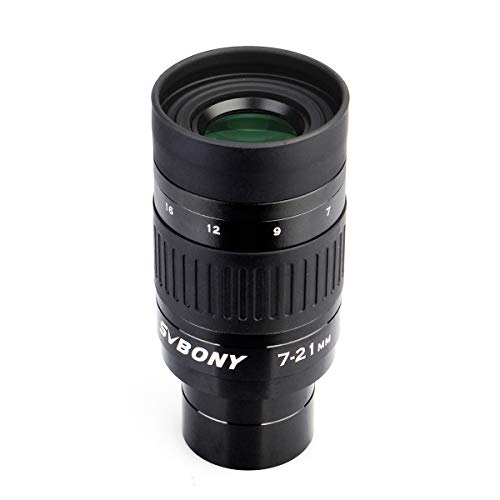
SVBONY SV135 7mm to 21mm Zoom Eyepiece
One eyepiece that covers most of the useful magnification range, which matters enormously when you are learning, because swapping eyepieces in the dark is how targets get lost. The apparent field narrows to about 40 degrees at the long end, which is the honest cost.
Best for: A first single eyepiece upgrade over the kit pair
Check price
Celestron X-Cel LX 9mm Eyepiece
Sixty degrees of field, 16 mm of eye relief and a rubber grip that you can find in the dark. Long eye relief at short focal length is what separates a comfortable planetary eyepiece from one you fight with, and it is the reason to spend three times the SVBONY price.
Best for: Planets and double stars, and anyone who observes in glasses
Check price
SVBONY 6mm 68 Degree Ultra Wide Angle Eyepiece
A 68 degree apparent field at 6 mm for under $35, which is the cheapest genuinely usable high power eyepiece on Amazon. Eye relief is tight and spectacle wearers will struggle, and that is the compromise the price buys.
Best for: Planetary detail on a budget in an f/5 to f/6 telescope
Check price
Explore Scientific 82 Degree 18mm Waterproof Eyepiece
Eighty two degrees is the field where a Dobsonian stops feeling like it is drifting, because the target takes far longer to cross. It is also nitrogen purged so it does not fog internally on a damp night, which is a real problem with cheaper wide fields.
Best for: Undriven Dobsonians, where a wide field means less nudging
Check price
Baader Hyperion Universal Mark IV 8mm to 24mm Zoom
The zoom that replaces a case of fixed eyepieces, holding 68 degrees at the short end and staying sharp across the range in fast telescopes. It costs more than four decent Plossls, and it is worth it only if you observe often enough that eyepiece swapping is genuinely costing you targets.
Best for: Frequent observers who want one eyepiece in the focuser all night
Check pricePrices change often, confirm on Amazon. As an Amazon Associate we earn from qualifying purchases.
Is a zoom eyepiece a good idea?
For most people, yes, and more so for beginners than for anyone else. The practical problem a zoom solves is not optical, it is procedural: swapping eyepieces in the dark loses targets, drops caps in the grass, and interrupts the moment when the seeing steadies and detail suddenly appears. A zoom lets you tune magnification to the night rather than jump between fixed steps.
The budget zoom covers 7 to 21 mm, which is most of the useful range, and narrows to about 40 degrees of apparent field at the long end. That narrowing is the honest cost and it is most noticeable exactly where you want width, when finding things. The premium zoom holds 68 degrees throughout and stays sharp in fast telescopes, and it costs about what four good fixed eyepieces cost, which is the trade.
A sensible compromise many observers land on: one wide low power fixed eyepiece for finding, a zoom for everything else, and a Barlow for the top end. That is three purchases covering the full range with one item in the focuser most of the night.
What about 2 inch eyepieces and barrel size?
The widest true field a telescope can deliver is limited by the largest field stop the focuser accepts, which is about 27 mm in a 1.25 inch barrel and about 46 mm in a 2 inch barrel. Run those through the field stop formula, true field equals 57.3 times field stop divided by telescope focal length, and the 2 inch barrel buys about 70 percent more sky at the widest setting.
Whether that matters depends on focal length. On a 650 mm telescope the 1.25 inch limit is already 2.38 degrees, which is plenty. On a 2032 mm telescope it is 0.76 degrees, which makes finding anything genuinely difficult, and a good diagonal plus a 2 inch eyepiece stops being a luxury. Note also that 2 inch eyepieces are heavy, frequently over two pounds, which matters both for mount balance and for the payload sum in the mount payload calculator.
What eyepieces should you not buy?
Three specific traps, all common in beginner bundles.
- Very short focal length simple eyepieces. A 4 mm Huygens or Ramsden in a beginner kit has around 2 mm of eye relief, which means pressing your eye against the glass to see a small, dim, distorted field. These exist to print a large magnification figure on the box, not to be used.
- 3x Barlows on slow telescopes. A 3x Barlow on an f/10 telescope produces an effective f/30, which pushes the exit pupil below 0.4 mm at almost any eyepiece. The image is dim, soft and rarely worth the trip.
- Large filter and eyepiece kits bought before you know what you use. A bundled accessory kit is genuinely good value if you want everything at once, but most observers find they use two of the eyepieces and one of the filters. Buying three good pieces usually beats buying nine average ones.
Above all, remember what an eyepiece cannot do. It cannot add aperture, it cannot beat atmospheric seeing, and it cannot make a telescope show colour in a nebula that human night vision cannot perceive. Work out what your aperture can actually deliver with the maximum useful magnification chart before buying anything at the short end.
Related tools and guides
Frequently asked questions
How many eyepieces do I actually need?
Three covers almost everything, and a Barlow makes it feel like five. A long eyepiece around a 5 mm exit pupil for finding targets and large clusters, a mid eyepiece around 2 mm for general deep sky observing, and a short eyepiece around 1 mm for planets and double stars. Buying six eyepieces before you know which magnifications you actually use is the most common way to waste money in this hobby.
What eyepiece focal lengths should I buy?
It depends entirely on the focal ratio of your telescope, which is why a fixed list is bad advice. Work from exit pupil instead: the eyepiece focal length that gives a given exit pupil is the exit pupil multiplied by the focal ratio. At f/5, a 2 mm exit pupil needs a 10 mm eyepiece. At f/10, the same 2 mm exit pupil needs a 20 mm eyepiece.
Are expensive eyepieces worth it?
It depends on the focal ratio of your telescope more than on your budget. At f/10 a simple Plossl looks sharp to the edge and a premium eyepiece buys mainly a wider field and better eye relief. At f/4.7 a Plossl shows visibly soft outer field and premium glass genuinely fixes it. Fast telescopes justify expensive eyepieces, slow telescopes largely do not.
Should I buy a zoom eyepiece instead of a set?
A zoom is an excellent first upgrade and a reasonable permanent solution. It removes eyepiece swapping in the dark, which is how targets get lost, and it lets you find the best magnification for the night rather than jumping between fixed steps. Budget zooms narrow to around 40 degrees of apparent field at the long end, which is the honest cost, and premium zooms hold 68 degrees throughout.
What is the longest eyepiece my telescope can use?
About 7 times the focal ratio in millimetres, because beyond that the exit pupil exceeds the roughly 7 mm of a dark adapted pupil and the surplus light lands on your iris. At f/5 that is a 35 mm eyepiece and at f/10 it is a 70 mm eyepiece, which does not exist in a usable form. This is why long focal ratio telescopes cannot deliver wide fields at all.
Do I need 2 inch eyepieces?
Only for the widest fields, and only if your focuser accepts them. The largest field stop that fits a 1.25 inch barrel is about 27 mm, which caps the true field. A 2 inch barrel allows about 46 mm and roughly 70 percent more sky. On a long focal length telescope that difference is what makes finding objects practical rather than frustrating.
How we choose: we compare published manufacturer specifications, optical figures we can verify, and reviews from owners who have used the equipment under real skies. We do not test gear in person. Never point any telescope, finder or binocular at the Sun without a certified full-aperture solar filter fitted over the front of the instrument.
Recording your own eyepieces, exit pupils and sessions? The Observing & Astrophotography Planner is the paid version of these pages: 8 printable worksheets you fill in with your own numbers, plus the full PDF, $29.