Best Telescope Eyepieces
The best all-around telescope eyepiece is the Celestron X-Cel LX 9mm at $109.95, a 60 degree apparent field, 16mm eye relief eyepiece well suited to planets and double stars in most telescopes, and the right way to plan a full set is by exit pupil, not by focal length alone.
Most eyepiece advice is given in focal length, which is the wrong unit to plan around, because a 9mm eyepiece behaves completely differently in a fast Newtonian than in a slow refractor. The number that actually transfers between telescopes is exit pupil, the diameter of the beam of light leaving the eyepiece, and planning a set around it is the fastest way to buy the right eyepieces once instead of guessing and rebuying. For most telescopes, the single best all-around eyepiece to add first is the Celestron X-Cel LX 9mm, a comfortable, long eye relief eyepiece that suits planetary and double star observing in almost anything.
What is exit pupil, and why should you plan by it instead of focal length?
Exit pupil is the eyepiece focal length divided by the telescope focal ratio, and it is also equal to telescope aperture divided by magnification. It describes the width of the beam of light actually reaching your eye, which is what determines how bright an image looks and how comfortable it is to observe with, independent of which telescope produced it. A 9mm eyepiece in an f/5 telescope yields a very different exit pupil, and a very different observing experience, than the same 9mm eyepiece in an f/10 telescope, which is exactly why focal length alone is a poor way to plan a set: the same number means something different every time the telescope changes. Exit pupil transfers. That is the whole argument for using it.
Exit pupil above about 7mm wastes light, because a dark-adapted adult pupil is roughly 7mm wide and shrinks further with age, so any exit pupil beyond that simply misses the eye entirely. Below about 0.5mm the view goes dim and mushy, an effect of diffraction that no amount of magnification recovers detail from. A useful eyepiece set lives comfortably between those two limits.
What three exit pupils should a basic set cover?
Roughly 5mm for finding, 2mm to 3mm for general use, and 1mm for planets, plus a Barlow to stretch whichever eyepieces you already own into the gaps between those settings.
- ~5mm, finding and sweeping. A wide, bright, low power view that fits more sky in the field at once, which is what actually helps locate a target before you center and magnify it.
- 2mm to 3mm, general use. The magnification range where most deep sky objects, double stars and casual planetary views spend the bulk of an observing session.
- ~1mm, planets. High power for resolving planetary detail and splitting tight double stars, usable only on nights when the atmosphere is steady enough to support it.
How does the same eyepiece behave differently in a fast and a slow telescope?
Take two commonly owned telescope speeds as reference points: a fast f/5 Newtonian, matching this site's own beginner pick, and a slow f/10 Schmidt-Cassegrain or long achromatic refractor. The same eyepiece produces a meaningfully different exit pupil in each.
| Eyepiece | Focal length | Exit pupil at f/5 | Exit pupil at f/10 |
|---|---|---|---|
| Celestron Omni 32mm Plossl | 32mm | 6.4mm | 3.2mm |
| SVBONY SV135 Zoom (long end) | 21mm | 4.2mm | 2.1mm |
| Baader Hyperion Zoom (long end) | 24mm | 4.8mm | 2.4mm |
| Explore Scientific 82° 18mm | 18mm | 3.6mm | 1.8mm |
| Celestron X-Cel LX 9mm | 9mm | 1.8mm | 0.9mm |
| SVBONY 6mm 68° | 6mm | 1.2mm | 0.6mm |
The same 9mm eyepiece sits at a comfortable 1.8mm exit pupil in the fast telescope and a much tighter 0.9mm exit pupil in the slow one, meaningfully dimmer and more demanding on a steady hand and steady seeing. Use our eyepiece calculator to check any eyepiece against your own telescope's actual focal ratio.
Are expensive eyepieces worth it, and does it depend on the telescope?
Expensive eyepieces earn their price in fast telescopes and largely do not in slow ones. A simple Plossl design is sharp essentially to the edge of the field in a slow f/10 telescope, because a slow focal ratio produces very little coma or field curvature for an expensive optical design to correct. The same Plossl, in a fast f/5 telescope, shows visibly soft, distorted stars toward the edge of the field, because a fast focal ratio bends light more steeply and exposes exactly the aberrations a Plossl's simple design cannot handle. That is precisely the situation a premium wide field eyepiece like the Explore Scientific 82 degree 18mm is built to fix, and it is worth its price in a fast Newtonian for exactly that reason. Buying the same eyepiece for a slow refractor or SCT is spending real money to fix a problem that telescope barely has.
Which eyepieces should you actually buy, by budget?
Present these as a ladder rather than a single winner, because the right eyepiece depends on your telescope's speed and which exit pupil gap you are trying to fill.
Telescope eyepieces by budget and use

Celestron Omni 32mm Plossl Eyepiece
The widest true field a 1.25 inch barrel can physically deliver, which makes it the eyepiece you actually find things with. A 52 degree Plossl at 32 mm is optically simple, sharp, and cheap, and every telescope should own one.
Best for: Finding targets and sweeping star fields
Check price
SVBONY 6mm 68 Degree Ultra Wide Angle Eyepiece
A 68 degree apparent field at 6 mm for under $35, which is the cheapest genuinely usable high power eyepiece on Amazon. Eye relief is tight and spectacle wearers will struggle, and that is the compromise the price buys.
Best for: Planetary detail on a budget in an f/5 to f/6 telescope
Check price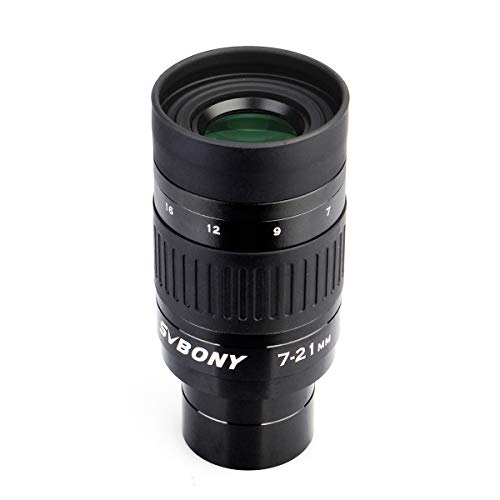
SVBONY SV135 7mm to 21mm Zoom Eyepiece
One eyepiece that covers most of the useful magnification range, which matters enormously when you are learning, because swapping eyepieces in the dark is how targets get lost. The apparent field narrows to about 40 degrees at the long end, which is the honest cost.
Best for: A first single eyepiece upgrade over the kit pair
Check price
Celestron X-Cel LX 9mm Eyepiece
Sixty degrees of field, 16 mm of eye relief and a rubber grip that you can find in the dark. Long eye relief at short focal length is what separates a comfortable planetary eyepiece from one you fight with, and it is the reason to spend three times the SVBONY price.
Best for: Planets and double stars, and anyone who observes in glasses
Check price
Baader Hyperion Universal Mark IV 8mm to 24mm Zoom
The zoom that replaces a case of fixed eyepieces, holding 68 degrees at the short end and staying sharp across the range in fast telescopes. It costs more than four decent Plossls, and it is worth it only if you observe often enough that eyepiece swapping is genuinely costing you targets.
Best for: Frequent observers who want one eyepiece in the focuser all night
Check price
Explore Scientific 82 Degree 18mm Waterproof Eyepiece
Eighty two degrees is the field where a Dobsonian stops feeling like it is drifting, because the target takes far longer to cross. It is also nitrogen purged so it does not fog internally on a damp night, which is a real problem with cheaper wide fields.
Best for: Undriven Dobsonians, where a wide field means less nudging
Check pricePrices change often, confirm on Amazon. As an Amazon Associate we earn from qualifying purchases.
The Celestron Omni 32mm Plossl delivers the widest true field a 1.25 inch barrel can physically manage, which is the eyepiece you actually find things with. The SVBONY SV135 Zoom covers most of a session's useful magnification range in one barrel, at the cost of a narrower apparent field at its long end. The SVBONY 6mm 68 degree is the cheapest genuinely usable high power eyepiece worth owning, with the honest tradeoff of tight eye relief. The X-Cel LX 9mm earns the top pick for its balance of eye relief, field and price. At the top, the Baader Hyperion Mark IV Zoom replaces a case of fixed eyepieces for a frequent observer, and the Explore Scientific 82 degree 18mm is nitrogen purged against internal fogging and built specifically to stay sharp in a fast, undriven Dobsonian.
Who should not buy the expert tier?
Anyone who owns only a slow telescope, roughly f/10 or slower, such as most Schmidt-Cassegrains and many achromatic refractors, should not spend $300 or more on the Baader Hyperion Zoom or the Explore Scientific 82 degree. As shown above, a slow focal ratio produces very little of the edge-of-field distortion these premium designs exist to correct, so a $50 Plossl looks nearly identical to a $400 eyepiece through that telescope. Save the money for a fast reflector where the difference is visible, or spend it on a mount upgrade instead, which will do more for the view than a premium eyepiece in a slow telescope ever will.
What does a Barlow lens actually change, and how do you plan around it?
A Barlow multiplies magnification and, equivalently, divides the eyepiece's effective focal length by its stated factor. Pairing the X-Cel LX 9mm with the Celestron Omni 2x Barlow behaves like a 4.5mm eyepiece, landing at roughly 0.9mm exit pupil in an f/5 telescope, squarely in the planetary range. The cheaper SVBONY 2x Barlow does the same optical job at a lower price with a simpler mechanical fit and finish. Stacking a stronger Barlow onto an already short eyepiece can overshoot the useful range entirely: the Celestron Luminos 2.5x Barlow on the same 9mm eyepiece behaves like a 3.6mm eyepiece, which in a slow f/10 telescope lands at roughly 0.4mm exit pupil, below the 0.5mm floor where the view goes dim and loses sharpness rather than gaining useful detail.
A 2x Barlow effectively doubles a small set: three eyepieces plus one Barlow behave like six distinct magnifications, which is usually a better first accessory purchase than a fourth eyepiece, because it multiplies the set already on hand rather than adding one more single-purpose focal length.
What about eye relief, and why does it matter for glasses wearers?
Eye relief is the distance your eye can sit from the eyepiece lens and still see the full field, and it matters most at short focal lengths, where a simple design can shrink eye relief to just a few millimeters. Anyone who observes in glasses needs more room than that to avoid pressing the lens against a spectacle lens, which is exactly the problem the X-Cel LX line solves with 16mm of eye relief across its shorter focal lengths, well above the roughly 6mm to 8mm typical of a budget short focal length eyepiece.
What is apparent field of view, and how does it interact with exit pupil?
Apparent field of view is how wide the view looks to your eye, independent of the telescope, and it is a property of the eyepiece design itself, printed as a degree figure such as the Omni 32mm Plossl's 52 degrees or the Explore Scientific 82 degree's namesake spec. True field of view, what the eyepiece actually shows of the real sky, is apparent field divided by magnification, so a wide apparent field eyepiece shows more real sky at the same magnification than a narrow one does. Exit pupil and apparent field are independent of each other: two eyepieces can share the same exit pupil and therefore the same image brightness while one shows a noticeably wider slice of sky than the other, which is the entire value proposition of a wide field design like the Explore Scientific 82 degree over a standard Plossl at a similar exit pupil and magnification.
A wider apparent field also means a target stays in view longer before drifting out of frame on an undriven telescope, since the eyepiece is showing more sky at once. That is a real, practical advantage on a manually pushed Dobsonian, and it is the specific reason wide field eyepieces are popular on exactly that kind of telescope rather than on a tracked, GoTo mount where drift is not a session-long annoyance.
How many eyepieces does a typical observer actually need?
Three, plus a Barlow, covers the vast majority of what most observers reach for across a season: one near 5mm exit pupil for finding, one near 2mm to 3mm for general deep sky and casual planetary use, and one near 1mm for planets and double stars on steady nights, with the Barlow filling gaps between them without a fourth or fifth single-purpose purchase. Owning more than that mostly buys convenience, not capability: a wider selection means less frequent Barlow swapping and finer steps between magnifications, which matters more to an experienced observer with specific preferences than to someone still learning which magnifications they actually reach for most nights. Resist the urge to buy a large eyepiece case before a season of actual use has shown which two or three magnifications get used every single session.
Related reading
- Eyepiece calculator, compute exit pupil and magnification for your telescope
- Eyepiece focal length to magnification chart
- Magnification calculator, check any eyepiece and telescope pairing
- Telescope magnification explained, the full concept walkthrough
- Best telescope for viewing planets, where high power eyepieces matter most
- Best Dobsonian telescope, the fast telescope category this page references
We review it on its own too, in full detail: the Baader Hyperion Mark IV zoom.
Frequently asked questions
What is the best eyepiece for most telescopes?
The Celestron X-Cel LX 9mm at $109.95. Sixty degrees of apparent field, 16mm of eye relief and a rubber grip make it comfortable for planets and double stars in almost any telescope, and long eye relief at a short focal length is what separates a comfortable high power eyepiece from one you fight with, especially for anyone observing in glasses.
What is exit pupil, and why does it matter more than focal length?
Exit pupil is the diameter of the beam of light leaving the eyepiece, equal to the eyepiece focal length divided by the telescope focal ratio. Unlike focal length alone, an exit pupil figure means the same thing in any telescope: a 2mm exit pupil looks similarly bright and similarly magnified whether it comes from a fast reflector or a slow refractor, which is what makes exit pupil the number worth planning a set around.
What three exit pupils should a basic eyepiece set cover?
Roughly 5mm for finding targets and sweeping star fields at low power, 2mm to 3mm for general use on most deep sky objects, and 1mm for high power planetary and double star work. A 2x Barlow extends whichever eyepieces you already own into that top range without a fourth eyepiece purchase, which is usually the more economical way to reach it.
Are expensive eyepieces worth it in a slow telescope?
Rarely. A simple Plossl design stays sharp to the edge of the field in a slow f/10 telescope, because there is little coma or field curvature at that focal ratio for an expensive design to correct. The same Plossl shows visibly soft, distorted stars toward the edge of the field in a fast f/5 telescope, which is exactly where a premium wide field eyepiece earns its price. Match the spend to the telescope speed, not the other way around.
Is a zoom eyepiece a good idea?
For convenience, yes; for outright sharpness at any single setting, a good fixed focal length eyepiece usually edges it out. A quality zoom like the Baader Hyperion Mark IV covers most of a session useful range without eyepiece swaps in the dark, which matters when changing eyepieces risks losing a faint target. Cheaper zooms narrow their apparent field noticeably at the long end, which is the honest tradeoff for the lower price.
Do I need a Barlow lens if I already own several eyepieces?
A 2x Barlow effectively doubles the number of exit pupils a small eyepiece set can reach, turning three eyepieces into six usable magnifications for the cost of one extra accessory. It is usually a better first purchase than a fourth eyepiece, because it multiplies the set you already own instead of adding one more single-purpose focal length.
How we choose: we compare published manufacturer specifications, optical figures we can verify, and reviews from owners who have used the equipment under real skies. We do not test gear in person. Never point any telescope, finder or binocular at the Sun without a certified full-aperture solar filter fitted over the front of the instrument.
Recording your own eyepieces, exit pupils and sessions? The Observing & Astrophotography Planner is the paid version of these pages: 8 printable worksheets you fill in with your own numbers, plus the full PDF, $29.