Best Telescope for Viewing Planets
The best telescope for viewing planets is the Celestron NexStar 8SE at $1,699.99, an 8 inch Schmidt-Cassegrain with a 2,032mm focal length and GoTo tracking. Planetary detail depends on long focal length and steady seeing more than raw aperture, and most nights cap useful magnification around 200x to 250x regardless of telescope size.
Planets are small, bright and unforgiving of a shaking mount, which makes them a different design problem than faint deep sky targets. Where a Dobsonian wins on raw aperture per dollar, a telescope built for planets wins on focal length, tracking and thermal stability, and the best choices in this category look almost nothing like the best choices for galaxies and nebulae. The best all around choice is the Celestron NexStar 8SE at $1,699.99, which packs a 2,032mm focal length and 8 inches of aperture into a tube short enough to carry in one hand.
Why does focal length matter more for planets than aperture does?
This does not mean aperture stops mattering for planets, only that it stops being the whole story. A larger mirror still resolves finer detail and gathers more light regardless of target, which is why the resolving power column below still favors the 8 inch scopes over the smaller ones. What changes for planetary work is that focal length decides how easily that resolving power translates into a comfortable, well framed, high power view.
Focal ratio is focal length divided by aperture, and it sets how much magnification a given eyepiece delivers: magnification equals telescope focal length divided by eyepiece focal length. A planet needs real magnification to show detail, since Jupiter and Saturn subtend only tens of arcseconds even at their closest approach to Earth. A long focal length telescope reaches a useful planetary magnification with an ordinary mid length eyepiece, while a short focal length telescope needs a Barlow lens stacked on a short eyepiece to get there, adding a second optical element and its own losses into the light path.
The NexStar 8SE at f/10 reaches 226x with a single 9mm eyepiece , no Barlow required. A fast f/5 Newtonian of similar aperture needs that same 9mm eyepiece paired with a 2x Barlow to reach a comparable 144x. Aperture still governs the resolving power ceiling, which is why an 8 inch scope out-resolves a 130mm one regardless of focal length; focal length decides how conveniently you get there.
How much magnification do you actually need for Jupiter and Saturn?
Atmospheric seeing caps most nights at 200x to 250x, regardless of aperture. The air above you is never perfectly still, and turbulence blurs fine planetary detail well before most telescopes reach their theoretical maximum useful magnification, which runs about 50x per inch of aperture, or 2x per millimeter. An 8 inch scope has a theoretical ceiling of 406x, but you will use it on only a handful of exceptionally steady nights a year. Most planetary observing happens between 100x and 250x.
| Telescope | Focal ratio | Max useful magnification | Magnification with a 9mm eyepiece | Resolving limit |
|---|---|---|---|---|
| StarSense Explorer LT 80AZ | f/11.3 | 160x | 100x | 1.4" |
| NexStar 130SLT (no Barlow) | f/5 | 260x | 72x | 0.9" |
| Sky-Watcher Skymax 127 | f/11.8 | 254x | 167x | 0.9" |
| Celestron NexStar 4SE | f/13 | 204x | 147x | 1.1" |
| NexStar 8SE | f/10 | 406x | 226x | 0.6" |
At 226x on the NexStar 8SE, the exit pupil works out to 0.9mm, well inside the roughly 0.5mm to 7mm usable range and typical for high power planetary work. Use the magnification calculator to check any eyepiece and telescope combination you own.
What is atmospheric seeing, and how do you judge it on a given night?
Seeing describes how steady the atmosphere is above you, and it is the practical ceiling on planetary detail on most nights, not your telescope. Air at different temperatures mixes constantly overhead, and each layer bends light slightly differently, so a star or planet image dances and blurs by an amount that has nothing to do with aperture. You can judge it roughly before ever looking through the eyepiece: stars twinkling noticeably to the naked eye, especially low in the sky, is a sign of poor seeing, while stars holding a steady, non-twinkling point is a sign of good seeing. Targets near the zenith almost always look better than targets low on the horizon, since light from a low target travels through far more turbulent air to reach you. A telescope with more aperture still resolves more detail on a bad night than a smaller one does, but neither one gets anywhere close to its theoretical maximum useful magnification until the air cooperates.
How does cool-down time affect a planetary observing session?
A telescope brought outside from a warm house is warmer than the night air, and the air trapped inside a closed tube design like a Maksutov or Schmidt-Cassegrain keeps circulating as it cools, creating its own small scale turbulence directly in the light path. That internal currents problem is separate from atmospheric seeing and is entirely within your control: give a Maksutov or SCT 30 to 45 minutes outside before serious planetary observing, and the image visibly sharpens over that window as the optics and the air inside the tube reach the outdoor temperature. Setting the telescope outside before sunset, or running a small cooling fan on models that have one built in, shortens the wait. Skipping this step is one of the most common reasons an expensive planetary telescope disappoints a new owner on the first night, and it has nothing to do with the optics being faulty.
Which telescope should you actually buy for planets?
Group the choices by focal length and tracking rather than by aperture alone, since a shorter, faster telescope can still perform well on planets with the right accessories, while a long, slow telescope reaches planetary magnifications almost effortlessly.
Telescopes for planetary observing, by budget

Celestron StarSense Explorer LT 80AZ
An 80 mm f/11 refractor, which is a long slow tube that behaves well on the Moon and planets and asks nothing of collimation. It is the cheapest thing in this list that is not a toy, and the honest limit is that 80 mm will not show you galaxies.
Best for: A tight budget where lunar and planetary viewing is the goal
Check price
Celestron NexStar 130SLT
A motorised GoTo 130 mm reflector with a database of roughly 4,000 objects. The tripod is the weak point and it is genuinely light for the tube, so anti vibration pads are close to mandatory rather than optional here.
Best for: Someone who wants tracking for the Moon and planets without a mount purchase
Check price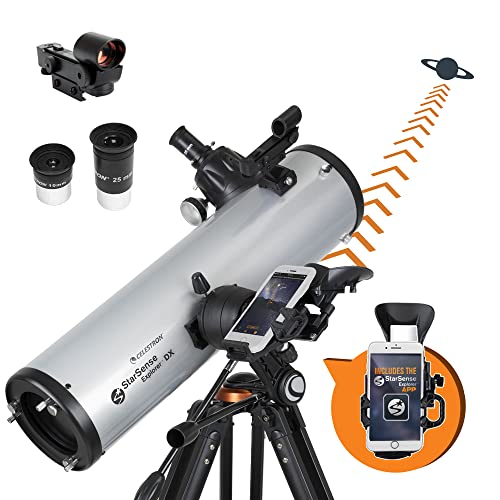
Celestron StarSense Explorer DX 130AZ
The same 130 mm f/5 optics as the tabletop, on a full tripod, with a phone dock that plate solves the sky and walks you onto the target with arrows. It is not a GoTo and nothing motorised moves, so no batteries and no alignment routine, but it removes the single thing that makes beginners quit.
Best for: Anyone in a light polluted suburb who cannot star hop yet
Check price
Celestron NexStar 8SE
An 8 inch Schmidt Cassegrain folds a 2,032 mm focal length into a tube you can carry in one hand, on a GoTo fork that tracks well enough for lunar and planetary imaging. It is the most capable telescope in this list that still fits in a car boot fully assembled.
Best for: Planetary detail and deep sky from a small storage space
Check price
Celestron NexStar Evolution 8 inch
The 8SE optics on a heavier fork with an internal lithium battery and WiFi control, which removes the power lead and the hand controller in one purchase. The mount is materially steadier than the 8SE fork, and that steadiness is most of what you are paying for.
Best for: An 8 inch SCT buyer who observes away from mains power
Check pricePrices change often, confirm on Amazon. As an Amazon Associate we earn from qualifying purchases.
Why does GoTo tracking matter specifically for planets?
Tracking matters everywhere, but it matters most at exactly the magnifications planets are viewed at. At 226x with the 9mm eyepiece, the NexStar 8SE's true field of view works out to roughly 0.27 degrees, using true field equals eyepiece apparent field divided by magnification. Earth's rotation carries any target across a field that narrow in well under a minute without tracking. A manually nudged Dobsonian handles that adequately for casual looking, but it becomes a real obstacle the moment you want to hand a planet to someone else to look at, run a planetary video camera for a stacked image, or simply observe for more than a couple of minutes without breaking concentration to recenter. GoTo tracking keeps the planet centered automatically, which is why every telescope in the Expert tier on this page includes it and why it is worth paying for specifically on a planetary telescope even if you would skip it on a wide field deep sky scope.
Is a Maksutov or a Schmidt-Cassegrain the better planetary design?
Both are catadioptric designs that fold a long focal length into a short tube using a mirror and a corrector lens, and both outperform a same-aperture fast Newtonian on planets without needing a Barlow. The Sky-Watcher Skymax 127, a Maksutov at f/11.8, is optically simple and essentially never needs collimation, but its thick corrector lens makes it slower to cool and heavier per inch of aperture than an SCT. The Celestron NexStar 4SE, a smaller Maksutov at f/13, trades aperture for portability and built in GoTo tracking in a genuinely compact package. The NexStar 8SE and its sibling, the NexStar Evolution 8 , are Schmidt- Cassegrains: thinner correctors than a Maksutov, more aperture per pound, and the widest GoTo fork mount selection in the hobby, at the cost of needing occasional collimation and the same 30 to 45 minute cool down every catadioptric design shares.
Why does a fast Newtonian need a good Barlow for planets?
A fast Newtonian like the NexStar 130SLT at f/5 is built to deliver a wide, bright, low power field naturally, which is the opposite of what planetary observing wants. Reaching a useful 144x with a 9mm eyepiece needs a 2x Barlow lens stacked in front of it. A cheap Barlow adds visible false color and softness at these powers, which is the one place on a budget Newtonian build where spending more on a single accessory pays off broadly across every eyepiece you own, since a good Barlow effectively doubles your eyepiece collection.
Do not stack a Barlow on top of an already long focal length instrument without checking the math first. A 2x Barlow on the NexStar 8SE with the same 9mm eyepiece would reach roughly 452x, which is past the telescope theoretical 406x ceiling and will look worse, not better, on essentially every night of the year.
When is the best time of year to observe a given planet?
For Mars, Jupiter and Saturn, the outer planets visible from Earth, the best window is around opposition, when Earth passes between the planet and the Sun and the planet is closest, brightest and up all night. Outside that window the planet still shows detail, just smaller and dimmer, and its position relative to Earth changes noticeably over a period of weeks. Jupiter and Saturn reach opposition roughly once a year, drifting later by about a month each year, while Mars reaches it only about every two years, which is why a good Mars apparition draws so much more attention among planetary observers than an average one.
Venus and Mercury work differently, since they orbit closer to the Sun than Earth does and are never visible in a fully dark sky. They are best observed near greatest elongation, when their angular distance from the Sun as seen from Earth is at a maximum, giving the longest window in twilight before the Sun rises or after it sets. Venus in particular shows a genuine crescent phase through a telescope near elongation, similar to the Moon's phases, which surprises many first time observers who did not expect a planet to show a phase at all.
Is a cheap high power eyepiece good enough for planets?
It can be, with one real compromise. The SVBONY 6mm 68 degree eyepiece costs under $35 and delivers genuinely usable high power views on a budget telescope, which makes it a fair first upgrade eyepiece. Its weak point is eye relief, the distance your eye can sit from the lens and still see the full field, which is tight enough that eyeglass wearers and anyone observing for long stretches will find themselves fighting the eyepiece to keep the image framed. The Celestron X-Cel LX 9mm costs about three times as much specifically to fix that: 16mm of eye relief and a similar effective magnification on most telescopes in this class, which is the difference between a comfortable hour long planetary session and a strained ten minute one. Buy the cheap eyepiece first to confirm you enjoy high power observing, then upgrade to the long eye relief version once you know you will use it often.
Does the viewing angle matter for high power planetary sessions?
More than it seems like it should. A planet observed near the zenith puts the eyepiece almost straight up on a straight through telescope like a Maksutov or refractor, which turns a comfortable session into a stiff neck within twenty minutes. A star diagonal bends the light path 90 degrees before it reaches the eyepiece, so you look down and across instead of straight up, and a dielectric coated diagonal like this one loses almost no light doing it. On the NexStar 8SE and other catadioptric designs a diagonal is essentially mandatory rather than optional, since the stock focuser position makes an un-diagonaled high altitude view nearly impossible to observe from comfortably for more than a minute or two.
What accessories actually improve planetary views?
Three items do more for planetary detail than any telescope upgrade under about $2,000. A long eye relief eyepiece in the 8mm to 10mm range holds enough eye relief that you are not fighting the eyepiece to see the field, which matters at the high powers planets are viewed at. A 2x Barlow lens extends any telescope's practical magnification range without buying more short focal length eyepieces. And a variable moon filter cuts glare on the Moon and on Venus, both bright enough to wash out contrast at high power without one.
Essential planetary accessories

Celestron X-Cel LX 9mm Eyepiece
Sixty degrees of field, 16 mm of eye relief and a rubber grip that you can find in the dark. Long eye relief at short focal length is what separates a comfortable planetary eyepiece from one you fight with, and it is the reason to spend three times the SVBONY price.
Best for: Planets and double stars, and anyone who observes in glasses
Check price
Celestron Omni 1.25 inch 2x Barlow Lens

Celestron Variable Moon Filter
Prices change often, confirm on Amazon. As an Amazon Associate we earn from qualifying purchases.
Related reading
- Best telescope eyepieces
- Planet viewing by aperture chart
- Schmidt-Cassegrain vs Newtonian
- Magnification calculator
We review them on their own too, in full detail: the Celestron NexStar 8SE and the NexStar 127SLT.
Frequently asked questions
What is the best telescope for viewing planets?
The Celestron NexStar 8SE at $1,699.99. It packs a 2,032mm focal length and an 8 inch aperture into a tube short enough to carry in one hand, which is the combination planetary observing actually rewards. GoTo tracking keeps a planet centered at high power instead of drifting out of the eyepiece every minute, which matters more here than on almost any other target.
Do I need a big telescope to see Saturn rings and Jupiter belts?
No. A 80mm refractor at around 100x already separates Saturn rings from its globe and shows two to three dark belts across Jupiter. Bigger aperture mainly buys sharper, higher contrast detail at higher power on steady nights, not the basic view itself. A long focal length matters more than a large mirror for planets specifically.
Why does focal length matter more than aperture for planets?
Because planets are small and bright, so the limiting factor is usable magnification and image scale, not light gathering. A long focal length telescope reaches a comfortable planetary magnification with a mid range eyepiece, while a short focal length telescope needs a Barlow stacked on a short eyepiece to reach the same power, adding complexity and light loss. Aperture still sets the resolving power ceiling, but focal length decides how easily you reach useful magnification.
Is a Maksutov or a Schmidt-Cassegrain better for planetary viewing?
Both suit planets well and outperform a same-aperture fast Newtonian for the purpose, since their long focal ratios reach high magnification without a Barlow. A Maksutov like the Skymax 127 is simpler and needs no collimation, but is heavier per inch of aperture and slower to cool. An SCT like the NexStar 8SE offers more aperture per pound and built in GoTo tracking, at the cost of very occasional collimation.
Why does a fast Newtonian need a good Barlow for planets?
A fast Newtonian, one with a short focal ratio around f/5, delivers a wide low power field naturally but needs real help reaching planetary magnifications. A 2x or 3x Barlow lens doubles or triples the focal length effectively, turning a 650mm f/5 reflector into the equivalent of a 1,300mm or 1,950mm instrument for that eyepiece. A cheap Barlow adds noticeable false color and softness at these powers, so this is one place where spending more on the Barlow specifically pays off.
Who should not buy an 8 inch SCT for planetary viewing?
Anyone who wants to walk outside and start observing in under ten minutes, since an SCT needs 30 to 45 minutes to reach thermal equilibrium before the view sharpens up. Anyone whose main interest is wide field deep sky objects like large nebulae and star clusters should also look elsewhere, since the long focal length that makes an SCT excellent on planets gives it a narrow true field of view. A grab and go refractor or a wide field Dobsonian serves those two groups better.
How we choose: we compare published manufacturer specifications, optical figures we can verify, and reviews from owners who have used the equipment under real skies. We do not test gear in person. Never point any telescope, finder or binocular at the Sun without a certified full-aperture solar filter fitted over the front of the instrument.
Recording your own eyepieces, exit pupils and sessions? The Observing & Astrophotography Planner is the paid version of these pages: 8 printable worksheets you fill in with your own numbers, plus the full PDF, $29.