Best Telescope Under $500
The best telescope under $500 is the Celestron StarSense Explorer DX 130AZ at under $500, a 130mm reflector with phone based plate solving on a stable tripod. Every option in this budget range gathers between 118x and 345x the light of the naked eye.
Five hundred dollars is the budget where a telescope search gets interesting: below it, you are mostly trading aperture for price on a fairly linear scale; at it, aperture, mount quality and a finding system start competing for the same dollars, and the right answer depends on which of those three you actually need most. The best all around pick under $500 is the Celestron StarSense Explorer DX 130AZ at under $500, which spends most of the budget on a proven 130 mm mirror and the rest on a full tripod and a phone dock that finds targets for you, a combination that suits more first time buyers than any single-purpose alternative at this price.
What does $500 actually buy in aperture?
Aperture is the diameter of the main mirror or lens, and it is the single number that governs how much light a telescope gathers and how fine a detail it can resolve. Magnification does not add detail the aperture never collected in the first place, which is why the cheap 60mm to 90mm "high power" scopes sold on magnification claims alone are a trap: 900x magnification on a 70mm lens produces a large, dim, blurry image, not a detailed one. None of the six telescopes on this page make that mistake; every one is sized honestly around what its aperture can actually deliver.
Under $500, aperture runs from 76 mm at the low end to 130 mm at the top of this list, and the difference is not small: a 130 mm mirror gathers roughly 2.9x the light of a 76 mm one for a bit more than six times the price. The table below lines up every real option at this budget against the two numbers that matter: light gathered and resolving power.
| Telescope | Budget | Aperture | Light vs. naked eye | Resolving limit | What you actually see |
|---|---|---|---|---|---|
| Celestron FirstScope Signature Series Moon Tabletop | Under $100 | 76 mm | 118x | 1.5" | A child, or a very small budget with expectations set correctly |
| Celestron StarSense Explorer LT 80AZ | Under $250 | 80 mm | 131x | 1.4" | A tight budget where lunar and planetary viewing is the goal |
| Sky-Watcher Heritage 130mm Tabletop Dobsonian | Under $500 | 130 mm | 345x | 0.9" | A first telescope for an adult or a teenager, used from a garden or a car boot |
| Celestron StarSense Explorer 130mm Tabletop | Under $500 | 130 mm | 345x | 0.9" | A first scope where the finding, not the aperture, is the obstacle |
| SVBONY SV503 80mm ED Refractor | Under $500 | 80 mm | 131x | 1.4" | Entering deep sky imaging without a four figure tube |
| Celestron StarSense Explorer DX 130AZ | Under $500 | 130 mm | 345x | 0.9" | Anyone in a light polluted suburb who cannot star hop yet |
Resolving limit is the Dawes limit in arcseconds, the closest two stars can sit and still be seen as separate points. A smaller number is sharper. On aperture per dollar the DX 130AZ sits in the middle of this list; the plain Heritage 130P is the cheapest way to the same 130 mm mirror, and noticeably cheaper than the DX 130AZ.
Which of these should you actually buy?
Group the choices by what problem they solve rather than by price alone. A tight budget, a finding system, and raw aperture are three different priorities, and this budget lets you buy any one of them well, just not all three at once.
Every real telescope under (and just over) $500

Celestron FirstScope Signature Series Moon Tabletop
A 76 mm tabletop reflector sold as a gift item. It genuinely shows lunar craters and the four Galilean moons, and it genuinely will not show much else. Buy it as a present or a second grab and go, never as the telescope somebody is hoping for.
Best for: A child, or a very small budget with expectations set correctly
Check price
Celestron StarSense Explorer LT 80AZ
An 80 mm f/11 refractor, which is a long slow tube that behaves well on the Moon and planets and asks nothing of collimation. It is the cheapest thing in this list that is not a toy, and the honest limit is that 80 mm will not show you galaxies.
Best for: A tight budget where lunar and planetary viewing is the goal
Check price
Sky-Watcher Heritage 130mm Tabletop Dobsonian
A 130 mm mirror on a tabletop Dobsonian base, which is the only mount type at this price that does not wobble. The collapsible tube drops it to something you carry outside one handed, and 130 mm is the smallest aperture that shows the Cassini division and real structure in the Orion Nebula.
Best for: A first telescope for an adult or a teenager, used from a garden or a car boot
Check price
Celestron StarSense Explorer 130mm Tabletop
Plate solving phone guidance on a tabletop base, so there is no tripod to wobble and nothing to align. It needs a real table or a stool at the right height, which is the one thing tabletop buyers underestimate.
Best for: A first scope where the finding, not the aperture, is the obstacle
Check price
SVBONY SV503 80mm ED Refractor
The cheapest ED doublet worth owning, and it ships with a field flattener, which is a real accessory that usually costs a couple of hundred dollars on its own. Focuser tolerances are looser than the Sky-Watcher, so expect to shim it if you load a heavy camera train.
Best for: Entering deep sky imaging without a four figure tube
Check price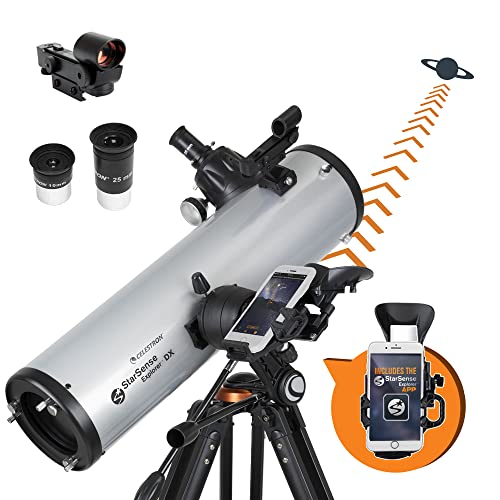
Celestron StarSense Explorer DX 130AZ
The same 130 mm f/5 optics as the tabletop, on a full tripod, with a phone dock that plate solves the sky and walks you onto the target with arrows. It is not a GoTo and nothing motorised moves, so no batteries and no alignment routine, but it removes the single thing that makes beginners quit.
Best for: Anyone in a light polluted suburb who cannot star hop yet
Check priceOrion SkyQuest XT6 Classic Dobsonian
A 6 inch f/8 Dobsonian, the classic first full size Dob. The long focal ratio is forgiving of cheap eyepieces and steadier on planets than a faster mirror the same size, at the cost of a taller tube than the 130 mm scopes on this page.
Best for: Stepping past 130 mm without leaving the Dobsonian format
Find on AmazonApertura AD8 Dobsonian
An 8 inch Dobsonian that ships with a two inch focuser, a right angle finder and a cooling fan already included, which normally cost extra elsewhere. It typically runs somewhat over this page ceiling, so it is the honest answer to "what if I stretch the budget."
Best for: Buyers willing to stretch the budget for 2.4x the light gathering
Find on AmazonBudget ranges are a guide; Amazon shows the current price. As an Amazon Associate we earn from qualifying purchases.
What do the StarSense Explorer versions add over the plain telescope?
Three of the six telescopes above share the same 130 mm f/5 mirror: the Heritage 130P, the StarSense Explorer 130mm Tabletop, and the StarSense Explorer DX 130AZ. The optics inside the tube are identical. What changes is the base and whether a phone dock is included that plate solves the sky and draws arrows to your target. That system adds a modest premium over the plain Heritage 130P, and it is worth it for almost anyone who does not already know the constellations, because not being able to find anything is a faster way to quit than owning slightly smaller optics.
Mechanically, the phone dock is simple: it holds your phone behind a mirror and a small lens built into the mount, and the app takes a photo of the star field through that optic, compares it against an internal star catalog, and calculates exactly where the telescope is pointed. From there it draws arrows on screen telling you which way to nudge the tube. It needs no internet connection once the app is installed and no separate GPS unit, since it works out position from the star pattern itself, and it needs no motors since your hands still do the moving. That is also its real limit: it points you at a target, it does not track one, so a planet or star still drifts out of a high power eyepiece within a minute or two and needs a manual nudge to recenter.
What is actually in the box at this budget?
Every telescope on this page ships as a working kit: the optical tube, a complete mount whether tabletop or tripod, two eyepieces spanning a low and a medium magnification, and a finder of some kind, either a simple optical finder or the StarSense phone dock. None of these six require a separate purchase to observe on the first clear night, which is not true of every telescope sold at this price point elsewhere; some budget bundles quietly omit a second eyepiece or ship a finder too weak to be useful, so it is worth confirming the listing includes both before buying outside this list.
What is worth budgeting for separately, even though none of it is required on day one: a red flashlight to protect your night vision, and on the two tripod mounted telescopes, a set of anti vibration pads. Both together cost under $50 and meaningfully improve the experience of every telescope on this page without changing which one to buy.
How long does it take to assemble one of these telescopes the first time?
Realistically thirty to sixty minutes for a first assembly on any of the tripod mounted models, mostly attaching the tripod legs, seating the tube in its rings or cradle, and fitting the finder or phone dock. The tabletop Dobsonians, the Heritage 130P and the StarSense Explorer 130mm Tabletop, are faster still since there is no tripod to build, often closer to fifteen minutes. None of the six require tools beyond what ships in the box, and none require any optical alignment out of the box beyond a quick finder check, which takes a few minutes in daylight before the first night out. Budget the full hour for the first session regardless of which one you buy, since reading the included instructions once thoroughly saves far more time than it costs.
Refractor or reflector: which design suits a first telescope under $500?
Four of the six telescopes above are Newtonian reflectors using a mirror, and one, the SV503, is a refractor using a lens. The practical difference at this budget comes down to maintenance and what the telescope is actually for. A reflector needs occasional collimation, the process of aligning its mirrors, which sounds harder than it is and takes most owners under five minutes once they have done it a couple of times with a simple collimation cap. A refractor like the StarSense LT 80AZ essentially never needs it, since there is no open tube to knock a mirror out of alignment, which is part of why refractors are popular as low maintenance grab and go scopes despite costing more per millimeter of aperture than a reflector of similar quality. The SV503 is a special case: it is a refractor built for imaging rather than visual use, with a narrower true field and a focal ratio chosen for a camera sensor rather than an eyeball, so it is the wrong pick if looking through an eyepiece is the actual goal.
How stable are the mounts at this budget, and is it worth upgrading one?
The tabletop Dobsonians on this page, the Heritage 130P and the StarSense Explorer 130mm Tabletop, sidestep the tripod problem entirely by having no tripod, which is a genuine advantage at this budget. The tripod mounted telescopes, the StarSense LT 80AZ and the StarSense DX 130AZ, use a lighter alt-azimuth tripod than the price alone might suggest, and both benefit noticeably from a set of anti-vibration pads under the tripod feet. They cost under $25, take thirty seconds to place, and cut down the settling time after you nudge the telescope from several seconds to well under one. This is one of the highest value small upgrades available at this budget, and it is worth buying alongside any tripod mounted telescope on this page rather than after the fact.
Is it worth going to a dealer instead of Amazon at this budget?
Two well regarded Dobsonians at this budget sell almost entirely through telescope dealers like High Point Scientific, Agena and OPT rather than through Amazon: the Orion SkyQuest XT6 Classic, a 6 inch f/8 Dobsonian that typically lands inside this budget, and the Apertura AD8, an 8 inch Dobsonian that usually runs somewhat over it once you include the accessories it ships with. Both are worth a search if you are willing to buy outside Amazon, and the links above search Amazon honestly rather than pointing at a wrong product, since neither currently has a verified Amazon listing worth linking to directly.
The Apertura AD8 in particular is the telescope this page ceiling exists to make you consider: it gathers 841x the light of the naked eye, against 345x for the DX 130AZ, for the price of a modest stretch past this page ceiling. If your budget has any flexibility at all, that is where it is best spent.
What should you skip spending money on at this budget?
- Extra eyepieces on day one. Every telescope above ships with at least two, and a third rarely gets used until you know which magnifications you actually reach for.
- A motorized GoTo mount under $500. The tracking motors and gearing that make GoTo worth having are expensive, and a budget GoTo mount at this price point is typically the weakest part of the whole telescope. Manual and StarSense assisted mounts outperform it here.
- Barlow lenses before you have used the stock eyepieces for a season. A Barlow doubles the magnification of the eyepieces you already own, and it is a more useful second purchase than a first one, once you know which powers you actually reach for most nights.
- A separate camera mount adapter for a scope you have not used yet. Phone afocal photography works through any of these eyepieces without an adapter for a first attempt, and it is worth confirming you enjoy pointing a phone through an eyepiece before buying hardware to make it easier.
If a future upgrade to a heavier tube or a tracking mount is somewhere in your plan, it is worth knowing the mount payload rule before you buy rather than after: a mount should carry no more than about half its rated maximum for the tracking or fine control to feel solid, which is useful even at this budget if you are weighing whether to buy a bigger tube now or a better mount first.
How do you know when you have outgrown a sub-$500 telescope?
Three signs show up in roughly the same order for most owners. First, faint deep sky targets like galaxies and dim nebulae start feeling like a ceiling rather than a stretch goal, since a 130 mm mirror resolves the bright showpiece objects well but runs out of light on fainter ones regardless of how good the night is. Second, you start reaching for maximum magnification more often, since a 130 mm scope theoretical ceiling sits around 260x and real nights rarely let any telescope use more than 200x to 250x anyway, so more aperture starts mattering only once you are already pushing that limit. Third, and most simply, you are still observing regularly a season or two in. That third sign matters more than the other two combined: the honest failure mode in this hobby is buying more telescope than gets used, not owning too little aperture.
How does this compare to spending more or less?
Below this budget, our beginner telescope guide covers the honest limits of a sub $250 first scope. Above it, the full 8 inch and larger ladder lives in best Dobsonian telescope, including the 10 inch and 12 inch models that sit well past this page's budget. If planets rather than deep sky objects are the real goal, best telescope for viewing planets covers why focal length matters more than aperture there.
Related reading
- Best telescope for beginners, the honest framing on mounts and expectations
- Best Dobsonian telescope, the full aperture ladder above $500
- 6 inch vs 8 inch telescope
- Telescope size calculator
- How to choose a telescope
We review them on their own too, in full detail: the StarSense Explorer DX 130AZ and the Sky-Watcher Heritage 130mm.
Frequently asked questions
What is the best telescope you can buy for under $500?
The Celestron StarSense Explorer DX 130AZ at under $500. It puts a well corrected 130 mm mirror on a full height tripod with slow motion controls, and adds a phone dock that plate solves the sky and points you at targets with arrows. Nothing else under $500 combines that much aperture with that much help finding things, which matters more than raw aperture for most first year owners.
Is it worth spending less than $200 on a first telescope?
Only for a gift or a genuinely tight budget with expectations set correctly. The Celestron FirstScope at under $100 and the StarSense LT 80AZ at under $250 both use real optics and both show the Moon and Jupiter moons honestly, but neither shows much beyond that. They are a reasonable way to test whether the hobby sticks before spending more, not a long term telescope for a committed observer.
Should I spend the full $500 or save toward an 8 inch Dobsonian?
It depends on patience more than money. An 8 inch Dobsonian like the Apertura AD8 typically runs somewhat over this budget and gathers roughly 2.4 times the light of a 130 mm scope. If you can wait a season and have somewhere to store a 48 lb tube, stretching the budget is worth it. If you want to start observing this month, everything on this page performs well and none of it is a wasted purchase later.
Do StarSense Explorer telescopes cost more for the same optics?
Yes, a modest premium over the plain version of the same mirror and tube. That premium buys the phone dock plate solving system, which finds targets without star hopping knowledge. It is a fair trade for most beginners, since not finding anything is a more common reason to abandon a telescope than the optics being slightly smaller than they could have been.
Is a 130 mm telescope big enough to be worth keeping long term?
For most visual observers, yes. A 130 mm mirror resolves the Cassini division in Saturn rings, cloud belts on Jupiter, and dozens of globular clusters into stars, which covers the majority of what a visual observer looks at in a typical year. Owners tend to upgrade for more aperture on faint deep sky targets or to add imaging, not because 130 mm stops being useful.
What is the SVBONY SV503 for, since it is not a Dobsonian?
It is an 80 mm ED doublet refractor built for imaging rather than visual observing, and it is the cheapest ED doublet worth owning at this budget. It ships with a field flattener that usually costs a couple of hundred dollars on its own. Buy it if astrophotography is the actual goal; buy a Dobsonian instead if looking through an eyepiece is the goal, since the SV503 has a narrower true field and a higher per-inch price for visual use.
How we choose: we compare published manufacturer specifications, optical figures we can verify, and reviews from owners who have used the equipment under real skies. We do not test gear in person. Never point any telescope, finder or binocular at the Sun without a certified full-aperture solar filter fitted over the front of the instrument.