Telescope Mount Payload Calculator
Use the manufacturer payload rating as a visual limit and about half of it for imaging. A mount rated at 30 lb holds 30 lb steady enough to look through but is comfortable at roughly 15 lb for long exposure photography, and everything above the mount head counts except the counterweights.
Here is the claim this whole site is willing to stand behind: the mount matters more than the telescope. A cheap telescope on a wobbly mount is the single most common reason beginners give up on astronomy, because a shaking image at 150x is unusable no matter how good the optics in front of it are. This calculator works out whether a given mount can actually carry a given telescope, and it deliberately reports two different limits, because visual observing and imaging are not the same problem.
Mount payload calculator
Add up everything that sits above the mount head. Counterweights do not count, because they balance the load rather than adding to it.
What does a payload rating actually mean?
It means the mount will hold that much mass without falling over or slipping, and it is measured with the load balanced and the clutches tight. It does not mean the mount will track that mass accurately, damp quickly after a touch, or hold position against a breeze. Those are the properties that decide whether observing is pleasant, and no manufacturer publishes them.
So the rating needs derating, and the amount depends on what you are asking the mount to do:
| Use | Fraction of rated payload | Why |
|---|---|---|
| Casual visual, low power | 100% | You can wait out a wobble at 40x, and often will not notice one |
| High magnification visual | 75% | Settling time is what you feel at 200x, not capacity |
| Lunar and planetary imaging | 70% | Video frames are short, so vibration blurs some frames and stacking discards them |
| Long exposure deep sky | 50% | Every second of settling is recorded as a smeared star |
| Deep sky in wind, or a long tube | 40% | Wind loading scales with tube surface area, not with mass |
The 50 percent rule for imaging is not a manufacturer figure and is not conservatism for its own sake. It exists because the failure mode is invisible until you inspect the frames: the mount looks fine, the guiding graph looks acceptable, and half the subframes have slightly elongated stars that no processing recovers.
What counts toward the payload?
Everything above the mount head except the counterweights. This is where most people underestimate, because they weigh the tube and forget that a working telescope is the tube plus a collection of attachments that each weigh a pound or two.
| Component | Typical weight | Notes |
|---|---|---|
| Optical tube, 80 mm ED refractor | 7 to 9 lb | The lightest useful imaging tube |
| Optical tube, 8 inch SCT | 12 to 14 lb | Compact for its aperture |
| Optical tube, 8 inch Newtonian | 18 to 22 lb | Long, and it catches wind badly |
| Tube rings and dovetail | 2 to 4 lb | Almost always forgotten in the sum |
| Finder scope or reflex finder | 0.3 to 1.5 lb | A Telrad is light, a 9x50 finder is not |
| Star diagonal, 2 inch dielectric | 1 to 1.5 lb | Adds leverage at the far end of the tube |
| Wide field eyepiece | 0.5 to 2.5 lb | A 2 inch 82 degree eyepiece is genuinely heavy |
| DSLR or mirrorless camera | 1.2 to 2 lb | Plus adapters and a flattener |
| Cooled astronomy camera | 1.3 to 2.2 lb | Plus a filter wheel at another 1.5 lb |
| Guide scope and guide camera | 1.5 to 3 lb | Imaging only, and easy to overlook |
| Focuser motor | 0.5 to 1 lb | At the very end of the lever arm |
An 8 inch Newtonian at 20 lb sounds like it fits a 30 lb mount comfortably. Add rings, a finder, a coma corrector, a camera, a guide scope and a focuser motor and the real figure is closer to 28 lb, which is 93 percent of the rating and roughly double the sensible imaging load. That arithmetic is why so many first imaging setups produce disappointing stars.
How do you test whether your mount is good enough?
You do not need instruments. Point at a bright star, fit your highest power eyepiece, focus, then tap the eyepiece end of the tube gently with one finger and count how long the image takes to stop moving.
| Settling time | Verdict | What to do |
|---|---|---|
| Under 1 s | Excellent | Nothing. This mount is not your limit |
| 1 to 2 s | Good | Normal for a well matched visual setup |
| 2 to 4 s | Tolerable | Add vibration pads, extend the tripod legs less, hang weight from the centre |
| 4 to 8 s | Poor | You will avoid high magnification without realising why |
| Over 8 s | Unusable at power | The mount, not the telescope, is what to replace |
Three cheap fixes come before buying anything. Do not extend the tripod legs fully, because the last few inches of extension cost more stiffness than any other change. Hang a weight from the tripod centre, a bag of sand or a water container, which lowers the centre of mass and damps the whole structure. And fit vibration suppression pads under the feet, which routinely halve settling time for very little and are the highest return accessory in this entire hobby per dollar spent.
What mount matches what telescope?
Working from the real payload rather than the tube weight alone, here is where the common pairings land. Every mount listed is one whose specification is published and verifiable.
| Mount | Rated | Visual limit | Imaging limit | Sensible pairing |
|---|---|---|---|---|
| Explore Scientific Twilight Nano | 14 lb | 14 lb | Not for imaging | A small refractor or a 4 inch Maksutov |
| Sky-Watcher AZ-GTi | 11 lb | 11 lb | 5 lb | A 72 to 80 mm refractor, grab and go |
| iOptron SkyGuider Pro | 11 lb | Tracker only | 5 lb | A camera and lens up to about 200 mm |
| Sky-Watcher Star Adventurer GTi | 11 lb | 11 lb | 5 to 6 lb | An 80 mm ED refractor plus camera |
| Celestron Advanced VX | 30 lb | 30 lb | 15 lb | An 8 inch SCT visually, a 6 inch Newtonian for imaging |
| Sky-Watcher EQ6-R Pro | 44 lb | 44 lb | 22 lb | An 8 inch Newtonian or a 9.25 inch SCT for imaging |
Two of those rows deserve reading twice. The AZ-GTi is an excellent grab and go mount and a poor imaging mount, and both are true at the same time. The EQ6-R Pro is what people buy after they have already bought a lighter mount and discovered its imaging limit, which is why it is frequently cheaper in the long run to buy it first.
Why is the mount worth more of the budget than the telescope?
Because a telescope has no failure mode that money cannot see. Optics of a given aperture from any reputable maker are broadly comparable, and the differences show up at the margins. A mount fails in ways that are obvious every single session: it shakes, it slips, it takes ten seconds to settle, it cannot be nudged smoothly, its slow motion controls have backlash, its tripod creeps on grass.
The old advice to spend half your budget on the mount is roughly right for visual observing and conservative for imaging, where two thirds on the mount is a defensible split. A useful sanity check: if you are choosing between a larger telescope on a marginal mount and a smaller telescope on a solid one, take the smaller telescope. It will show you more, because you will actually use high magnification on it.
That is also the honest reason department store telescopes fail. The optics in a 76 mm reflector are usually adequate for what 76 mm can do. The aluminium tripod under it is not, and no amount of aperture or magnification compensates for an image that never stops moving. Read the alt-azimuth versus equatorial comparison before choosing a mount type, and the mount roundup for specific models at each budget.
Related tools and guides
Frequently asked questions
How much weight can a telescope mount really carry?
Take the manufacturer rating as a visual figure and use about half of it for imaging. A mount rated for 30 lb will hold 30 lb of telescope steady enough to look through, but long exposure imaging on the same mount is comfortable at around 15 lb. The rating describes what will not fall over, not what will track accurately, and those are different questions.
What counts toward the payload?
Everything above the mount head except the counterweights. That means the optical tube, the rings and dovetail, the finder, the diagonal, the eyepiece or camera, a guide scope and guide camera, a focuser motor and any dew heater controller strapped to the tube. People routinely calculate the tube weight and then hang another six pounds of accessories off it.
Why does an underrated mount ruin a good telescope?
Because vibration is magnified along with the image. At 200x a tremor of a fraction of a millimetre at the eyepiece becomes a visible jump, and a mount at its limit takes five or ten seconds to settle after every focus adjustment. A superb telescope on an inadequate mount delivers a worse view than a mediocre telescope on a solid one, which is why the mount deserves the larger share of a budget.
Do I need a heavier mount for astrophotography?
Yes, substantially. Visual observing tolerates a mount that settles in a few seconds because you simply wait. A long exposure records every one of those seconds as a smeared star. Halving the rated payload is the accepted rule of thumb, and imagers who ignore it usually end up buying the heavier mount anyway after a season of discarded frames.
How do I know if my tripod is the weak point?
Tap the eyepiece end of the tube gently while looking through it at high magnification and count how long the image takes to stop moving. Under two seconds is good, two to five seconds is tolerable, and anything longer than five seconds means the tripod, not the head, is limiting you. Vibration suppression pads under the feet usually cut settling time by half for a modest cost.
Are counterweights part of the payload rating?
No. The rating describes the mass carried on the telescope side of the axis, and the counterweights exist to balance that mass. Adding counterweight does not raise the payload capacity, it only rebalances the load already there. Adding too much counterweight to compensate for an overloaded mount increases the total stress on the bearings rather than relieving it.
How we choose: we compare published manufacturer specifications, optical figures we can verify, and reviews from owners who have used the equipment under real skies. We do not test gear in person. Never point any telescope, finder or binocular at the Sun without a certified full-aperture solar filter fitted over the front of the instrument.
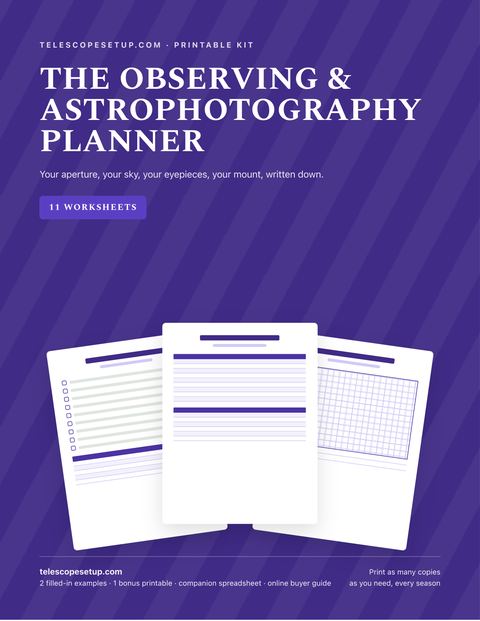
Recording your own numbers, eyepieces and sessions? The Observing & Astrophotography Planner is the paid version of these pages: 11 printable worksheets you fill in with your own numbers, plus the full PDF, a companion spreadsheet and two filled-in examples, $29.